


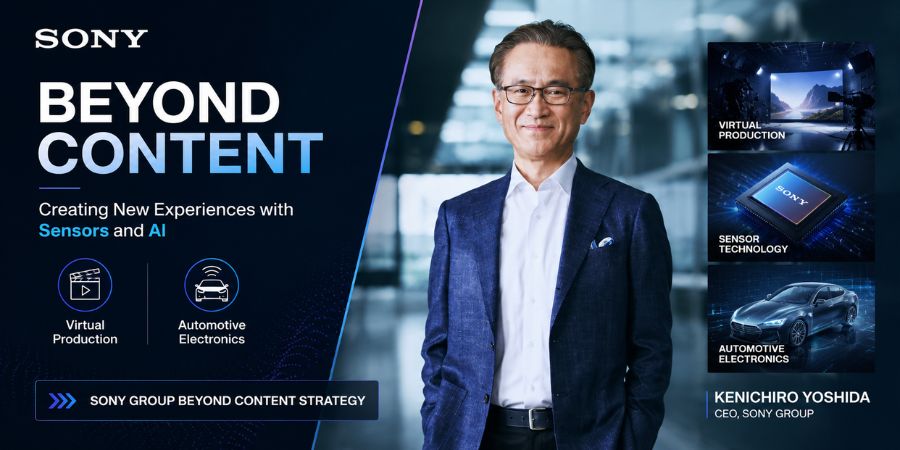
Sony Expands Beyond Entertainment With AI and Sensor Technology
Kenichiro Yoshida has unveiled a major strategic shift for Sony Group, positioning the company beyond its traditional entertainment and gaming identity. The new “beyond content” strategy aims to combine Sony’s advanced image sensor technology with artificial intelligence to create next-generation experiences in virtual production, mobility, and automotive electronics.
The move highlights Sony’s ambition to evolve into a broader AI and sensor technology powerhouse while strengthening its influence across multiple high-growth industries.
Sony Group Beyond Content Strategy Targets New Industries
Under the Sony Group Beyond Content Strategy, the company plans to integrate AI-driven technologies with its highly successful semiconductor and imaging businesses. Sony’s image sensors already power many leading smartphones and professional camera systems worldwide, giving the company a strong technological foundation.
Now, Sony is looking to expand those capabilities into virtual production studios, AI-assisted filmmaking, smart mobility platforms, and automotive electronics. Industry analysts believe this diversification could significantly strengthen Sony’s long-term revenue streams beyond movies, music, and gaming.
The strategy also reflects growing global demand for AI-powered visual technologies across entertainment and transportation sectors.
Why Sony’s AI Expansion Is Trending
The announcement is trending because it represents a major evolution for Sony’s business identity. For decades, Sony was primarily recognized for consumer electronics, PlayStation gaming, music, and film production. However, the company is now increasingly being viewed as a serious technology infrastructure leader.
Investors and industry experts see the Sony Group Beyond Content Strategy as a successful example of how legacy entertainment brands can adapt to the AI era. Sony’s strong expertise in sensors, imaging, and hardware gives it a competitive advantage that many AI-focused firms lack.
The company’s push into automotive electronics is also attracting attention as global automakers continue investing heavily in AI-driven vehicle systems, autonomous technologies, and advanced in-car experiences.
Virtual Production and Automotive Electronics Become Key Focus Areas
Sony’s expansion into virtual production comes at a time when film studios and streaming platforms are rapidly adopting AI-enhanced production workflows. By combining real-time imaging sensors, AI processing, and immersive production technologies, Sony aims to create more efficient and visually advanced filmmaking environments.
In the automotive sector, Sony continues exploring smart mobility opportunities through advanced sensing systems and intelligent electronics. The company has already demonstrated strong interest in mobility innovation through previous partnerships and prototype vehicle initiatives.
Experts believe Sony’s sensor leadership could become increasingly valuable as AI-powered vehicles require more sophisticated imaging and environmental detection systems.
Sony’s Transformation Signals a Broader Industry Shift
The Sony Group Beyond Content Strategy signals a broader transformation happening across the global technology industry, where companies are increasingly blending entertainment, AI, semiconductor technology, and mobility solutions into unified ecosystems.
For Sony, the strategy could open new opportunities in enterprise technology, industrial AI applications, and future consumer experiences powered by intelligent sensing systems.
As AI adoption accelerates worldwide, Sony’s ability to combine hardware expertise with advanced content technologies may position the company as one of the most influential diversified tech leaders of the coming decade.
Also Read: GSK Sino Biopharmaceutical Partnership: Emma Walmsley’s Big Pharma Move