


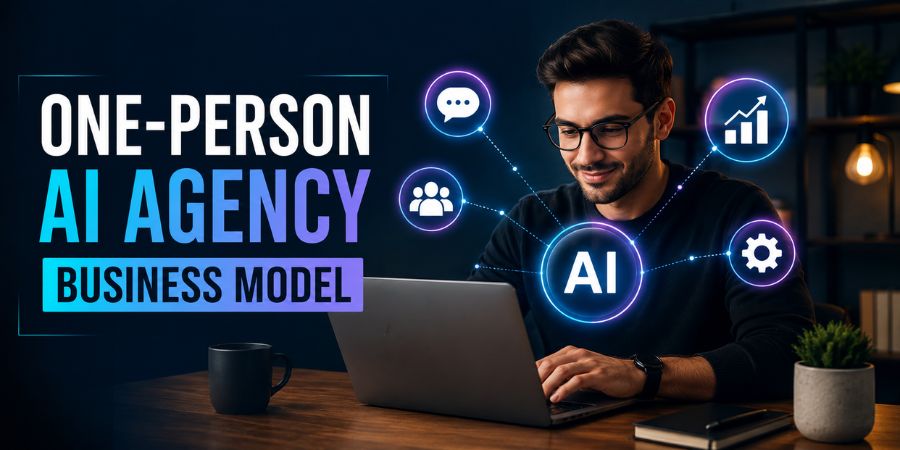
A freelance designer in Mumbai recently replaced three separate software subscriptions with a single AI workflow and ended up delivering client projects twice as fast while working fewer hours. Around the same time, a marketing consultant in London quietly scaled to six figures without hiring a team, renting office space, or even attending daily meetings. Stories like these are becoming surprisingly common because the business landscape has shifted in a dramatic way. The rise of automation tools, AI copilots, workflow systems, and intelligent content engines has created a completely new opportunity for independent professionals. The One-person AI agency business model is no longer an experimental idea discussed in online communities. In 2026, it has become one of the most practical and profitable ways to build a modern digital business with low overhead and high scalability.
What Is the One-Person AI Agency Business Model?
The One-person AI agency business model is a business structure where a single founder uses artificial intelligence tools, automation systems, and streamlined workflows to offer services that traditionally required an entire team. Instead of hiring separate employees for writing, design, customer support, research, analytics, editing, lead generation, and project management, the agency owner uses AI systems to perform large portions of those tasks.
This model allows one person to operate like a compact digital agency while maintaining control over strategy, client communication, and final output quality. The founder becomes less of a traditional freelancer and more of an operator managing intelligent systems.
Unlike old freelance models that depended heavily on hourly work, the One-person AI agency business model focuses on leverage. One person can now handle multiple clients simultaneously because AI dramatically reduces production time.
Core Components of This Business Model
A successful solo AI agency usually combines several elements together:
- AI content creation tools
- Workflow automation software
- CRM and client management systems
- AI-powered analytics
- No-code automation platforms
- Prompt engineering systems
- AI-assisted marketing tools
- Scalable digital service packages
The combination of these systems allows solo founders to create output that once required an entire department.
Why the One-Person AI Agency Business Model Is Growing So Fast
Several major shifts have pushed this model into the mainstream in 2026.
AI Tools Have Become Much Smarter
A few years ago, AI tools were inconsistent and required constant manual correction. Today, modern AI systems can write marketing copy, generate visuals, analyze customer data, summarize meetings, automate onboarding, create presentations, optimize ads, and even build websites with remarkable efficiency.
Because of this evolution, the One-person AI agency business model has become realistic for ordinary professionals, not just technical experts.
Businesses Want Faster Results
Companies increasingly care about speed and flexibility. Large agencies often move slowly because of internal processes, meetings, approval layers, and staffing costs. A solo AI agency can often deliver projects in days instead of weeks.
Clients appreciate:
- Faster turnaround times
- Lower costs
- Direct communication
- Flexible packages
- Specialized expertise
- Faster revisions
This makes the One-person AI agency business model attractive to startups, creators, coaches, SaaS brands, and small businesses.
Remote Work Changed Expectations
The global shift toward remote collaboration normalized online service businesses. Clients are now comfortable working with specialists from anywhere in the world.
A one-person AI agency can serve international clients without needing physical infrastructure. This dramatically lowers startup barriers.
Automation Reduced Operational Stress
Traditional agencies spend enormous time handling repetitive tasks. AI automation now removes much of that burden.
Tasks commonly automated include:
- Client onboarding
- Appointment scheduling
- Follow-up emails
- Social media scheduling
- Reporting
- Proposal generation
- Lead qualification
- Research summaries
- Data entry
This operational efficiency is a major reason why the One-person AI agency business model continues growing rapidly.
How the One-Person AI Agency Business Model Actually Works
At first glance, it may sound unrealistic that one person can manage agency operations alone. The reality becomes clearer when you understand the workflow structure.
A solo AI agency owner typically focuses on four core responsibilities:
- Client acquisition
- Strategy and decision-making
- Quality control
- Relationship management
Most repetitive production work is accelerated using AI tools.
For example, a content marketing agency owner may:
- Use AI for content outlines
- Generate first drafts automatically
- Use SEO AI tools for optimization
- Automate keyword clustering
- Schedule publishing through automation
- Create reports using AI dashboards
The founder then reviews, edits, improves, and personalizes the final output.
The same structure applies to design agencies, video editing services, social media agencies, email marketing firms, SEO consultancies, and automation agencies.
Best Niches for the One-Person AI Agency Business Model in 2026
Not every service works equally well for solo AI agencies. Some industries naturally benefit more from automation and AI-enhanced workflows.
AI Content Marketing Agency
Content creation remains one of the strongest opportunities.
Services may include:
- Blog writing
- SEO optimization
- LinkedIn ghostwriting
- Newsletter creation
- Video scripts
- Product descriptions
- Content repurposing
AI dramatically reduces research and drafting time, allowing one person to handle larger content volumes.
AI-Powered Social Media Agency
Many businesses struggle to maintain consistent social media activity. Solo AI agencies can offer:
- Content calendars
- AI-generated captions
- Reels scripting
- Community management assistance
- Scheduling automation
- Trend analysis
The One-person AI agency business model fits perfectly here because automation tools simplify repetitive posting tasks.
AI Automation Consulting
Businesses increasingly need help connecting tools and streamlining workflows.
Services include:
- CRM automation
- Email workflow creation
- AI chatbot setup
- Zapier integrations
- Internal workflow optimization
- Lead management automation
This niche often commands premium pricing because automation directly saves companies money.
AI SEO Agency
SEO agencies are rapidly evolving with AI assistance.
A solo operator can now manage:
- Keyword research
- Topical clustering
- Technical audits
- AI-assisted content optimization
- Metadata generation
- SEO reporting
The One-person AI agency business model allows SEO specialists to scale without building large teams.
AI Video Editing Agency
Modern AI video tools can now:
- Generate captions
- Remove pauses
- Improve audio
- Create highlights
- Repurpose long-form videos
- Generate shorts automatically
One skilled creator can manage multiple clients efficiently.
The Biggest Advantages of the One-Person AI Agency Business Model
Extremely Low Startup Costs
Traditional agencies often require:
- Employees
- Office rent
- HR systems
- Payroll management
- Equipment
- Administrative staff
A solo AI agency can launch with only a laptop, subscriptions, and internet access.
This low-risk entry point makes the One-person AI agency business model highly attractive for new entrepreneurs.
Higher Profit Margins
Lower operational costs naturally create better margins.
Instead of paying large teams, solo founders retain most of the revenue while AI handles much of the production support.
Many one-person agencies reach profitability faster than traditional startups.
Full Creative Control
Solo founders maintain complete control over:
- Brand direction
- Pricing
- Service quality
- Communication style
- Client selection
- Workflow systems
This flexibility allows faster experimentation and decision-making.
Scalability Through Systems
The One-person AI agency business model scales differently from traditional businesses.
Instead of hiring aggressively, founders often scale through:
- Better automation
- Productized services
- Templates
- AI workflows
- Standard operating procedures
- Subscription-based offers
This creates a leaner business structure.
Better Lifestyle Flexibility
Many people choose this model because it supports:
- Remote work
- Flexible schedules
- Independent decision-making
- Travel-friendly operations
- Reduced stress
- Smaller management burden
For digital entrepreneurs prioritizing freedom, this model offers a compelling alternative.
The Hidden Challenges Nobody Talks About
While the One-person AI agency business model has huge potential, it also comes with real challenges.
Burnout Can Happen Quickly
Operating alone means managing:
- Sales
- Marketing
- Client support
- Operations
- Finance
- Delivery
- Strategy
Even with AI assistance, mental overload can become a serious issue.
Successful founders usually solve this by creating systems early instead of constantly improvising.
Quality Control Matters More Than Ever
AI-generated work still requires human refinement.
Clients can easily notice:
- Generic writing
- Repetitive outputs
- Poor strategy
- Robotic communication
- Weak branding
The most successful solo AI agencies use AI as an assistant, not a replacement for expertise.
Client Trust Takes Time
Some clients remain skeptical about AI-powered services.
They may worry about:
- Content originality
- Privacy concerns
- Brand voice consistency
- Output quality
- Ethical issues
Building trust through transparency and strong results becomes essential.
Tool Overload Is Real
New AI platforms launch constantly.
Many founders waste time:
- Testing endless tools
- Chasing trends
- Switching systems repeatedly
- Buying unnecessary subscriptions
The smartest agency owners focus on mastering a small number of reliable tools.
Essential Tools for a One-Person AI Agency in 2026
The right technology stack can dramatically improve efficiency.
AI Writing Tools
These help with:
- Blog drafts
- Marketing copy
- Email campaigns
- Research summaries
- Scriptwriting
Strong prompting skills make a huge difference in output quality.
Automation Platforms
Automation systems connect workflows together.
Popular use cases include:
- Automated onboarding
- Lead routing
- Reporting
- Follow-up systems
- CRM updates
- Task creation
AI Design Tools
These platforms simplify:
- Social graphics
- Presentations
- Ad creatives
- Thumbnail creation
- Branding assets
AI Research and Analytics Tools
Data-driven agencies rely heavily on:
- Competitor analysis
- Trend tracking
- SEO monitoring
- Audience insights
- Performance reporting
Project Management Systems
Even solo operators need organization.
Effective systems improve:
- Deadlines
- Client communication
- File management
- Workflow visibility
- Team collaboration with contractors
The One-person AI agency business model works best when operations feel structured rather than chaotic.
How to Start a One-Person AI Agency Business Model From Scratch
Starting does not require massive funding or technical expertise.
Step 1: Choose a Profitable Niche
Avoid trying to serve everyone.
Strong niche examples include:
- AI content for SaaS startups
- AI SEO for local businesses
- AI social media for coaches
- AI automation for e-commerce brands
- AI email marketing for creators
Specialization improves positioning and pricing power.
Step 2: Create One Core Offer
Many beginners fail because they offer too many services.
Instead, focus on a single clear offer such as:
- Monthly SEO package
- Weekly LinkedIn content
- AI automation setup
- Email funnel management
- Video repurposing service
The One-person AI agency business model performs best when services are streamlined.
Step 3: Build Repeatable Systems
Document processes from the beginning.
Create:
- Templates
- Prompt libraries
- Checklists
- SOPs
- Automation flows
These systems become the foundation of scalability.
Step 4: Focus on Client Acquisition
Most solo agencies grow through:
- LinkedIn networking
- Twitter content
- Cold email outreach
- Personal branding
- Referrals
- Case studies
- Niche communities
Consistent visibility matters more than perfection.
Step 5: Productize Your Services
Instead of custom pricing for every project, create packaged services.
Examples:
- 12 SEO blogs monthly
- 30 social posts weekly
- AI workflow setup package
- Monthly newsletter management
This simplifies sales and operations.
Pricing Strategies for the One-Person AI Agency Business Model
Pricing can determine whether the business becomes sustainable.
Avoid Pure Hourly Pricing
Hourly pricing limits scalability.
The value comes from:
- Expertise
- Systems
- Efficiency
- Results
- Strategic thinking
Clients pay for outcomes, not time spent.
Use Value-Based Pricing
If your AI systems help a business generate:
- More leads
- Higher conversions
- Better engagement
- Faster operations
- Increased revenue
You can justify premium pricing.
Offer Retainers
Monthly retainers create predictable revenue.
Popular retainer models include:
- SEO management
- Social media management
- Content production
- AI workflow support
- Email marketing management
The One-person AI agency business model becomes far more stable with recurring income.
Building a Personal Brand Around Your Agency
Personal branding plays a massive role in solo business growth.
Clients often choose one-person agencies because they want direct access to expertise.
Why Personal Branding Matters
A visible founder creates:
- Trust
- Authority
- Familiarity
- Audience growth
- Referral opportunities
People increasingly buy from individuals rather than faceless companies.
Best Platforms for Growth
Different platforms support different agency types.
Excellent for:
- B2B agencies
- Consulting
- SEO services
- Automation services
- Lead generation
X and Threads
Useful for:
- Building thought leadership
- Networking
- Industry visibility
- Audience engagement
YouTube
Powerful for:
- Tutorials
- Case studies
- AI education
- Long-term authority
Instagram and TikTok
Ideal for:
- Creative agencies
- Video services
- Social media services
- Design-focused businesses
The One-person AI agency business model often grows faster when the founder consistently shares insights publicly.
Common Mistakes Beginners Make
Depending Too Much on AI
AI should improve expertise, not replace it.
Weak strategy combined with AI still produces weak results.
Offering Too Many Services
Trying to be a full-service agency usually creates confusion and operational overload.
Focused offers scale more efficiently.
Ignoring Human Communication
Clients still value:
- Responsiveness
- Creativity
- Strategic thinking
- Emotional intelligence
- Relationship-building
The human layer remains essential.
Chasing Every Trend
Not every AI tool matters.
Founders who constantly switch systems often lose momentum.
Underpricing Services
Many solo founders assume AI-generated efficiency means cheaper pricing.
In reality, clients pay for results and convenience.
Can the One-Person AI Agency Business Model Replace Traditional Agencies?
This question appears constantly in business discussions.
The answer is nuanced.
Large traditional agencies still hold advantages in:
- Enterprise contracts
- Massive campaigns
- Large-scale creative teams
- Complex brand management
- International operations
However, the One-person AI agency business model is disrupting mid-sized and small agency markets rapidly.
Many businesses now prefer:
- Smaller teams
- Faster execution
- Lower costs
- Specialized expertise
- Direct founder communication
As AI improves, solo agencies will continue competing more effectively against traditional firms.
Realistic Income Potential in 2026
Income varies dramatically based on niche, positioning, and systems.
Beginner Stage
New solo agencies may earn:
- $1,000 to $5,000 monthly
This stage usually involves:
- Learning workflows
- Building case studies
- Refining offers
- Acquiring first clients
Growth Stage
Established operators often reach:
- $10,000 to $30,000 monthly
At this point, systems become more efficient.
Advanced Stage
High-level operators with strong personal brands and premium positioning can scale significantly beyond this.
Some combine:
- Consulting
- Courses
- Memberships
- Templates
- Digital products
- SaaS tools
The One-person AI agency business model becomes especially powerful when paired with audience-building.
Future Trends Shaping the One-Person AI Agency Business Model
The next few years will dramatically evolve this industry.
AI Agents Will Automate Entire Workflows
Instead of isolated tools, AI agents will increasingly:
- Execute tasks autonomously
- Manage workflows
- Coordinate systems
- Analyze performance
- Generate strategic recommendations
This will further increase solo founder leverage.
Hyper-Specialized Agencies Will Grow
Generalist agencies may struggle.
Clients increasingly prefer niche specialists such as:
- AI SEO for lawyers
- AI content for SaaS founders
- AI automation for dentists
- AI video editing for creators
Specific positioning improves credibility.
Hybrid Human-AI Expertise Will Win
Businesses do not want purely robotic outputs.
The strongest agencies will combine:
- Human creativity
- Strategic thinking
- Emotional intelligence
- AI-powered efficiency
This hybrid approach will dominate.
Subscription-Based Agency Models Will Increase
Instead of one-time projects, more agencies will offer:
- Monthly content systems
- AI support retainers
- Ongoing automation management
- Continuous optimization services
Recurring revenue improves long-term stability.
Is the One-Person AI Agency Business Model Worth It in 2026?
For many entrepreneurs, the answer is yes.
This model offers a rare combination of:
- Low startup costs
- High scalability
- Geographic freedom
- Strong profit potential
- Creative independence
- Flexible operations
However, success still requires:
- Consistency
- Client acquisition skills
- Strategic thinking
- Communication ability
- System-building discipline
AI can accelerate execution, but it cannot replace judgment, positioning, and trust.
The One-person AI agency business model rewards operators who think like business owners rather than freelancers.
How to Stay Competitive Long-Term
The AI industry changes rapidly, which means adaptation matters.
Keep Learning
Successful founders continuously improve:
- Prompt engineering
- Automation workflows
- Marketing strategy
- AI integrations
- Sales systems
Build Proprietary Systems
The strongest agencies eventually create unique internal frameworks.
This creates differentiation beyond simply using public AI tools.
Focus on Results Over Deliverables
Clients ultimately care about outcomes.
Position services around:
- Revenue growth
- Lead generation
- Audience expansion
- Operational efficiency
- Brand visibility
Develop Strong Communication Skills
Even highly automated agencies depend on trust.
Clear communication remains a competitive advantage.
FAQs
Why is the One-person AI agency business model becoming popular?
The One-person AI agency business model is becoming popular because AI tools allow solo founders to deliver services faster, reduce operational costs, automate repetitive tasks, and scale without large teams.
How much money can a one-person AI agency make?
Income depends on niche, pricing, and client acquisition. Many solo founders earn a few thousand dollars monthly at the beginning, while advanced operators can generate six-figure annual revenue or more.
What skills are needed for the One-person AI agency business model?
Important skills include communication, marketing, automation setup, client management, strategic thinking, sales, prompt engineering, and workflow optimization.
Where can clients be found for a solo AI agency?
Clients are commonly found through LinkedIn, cold outreach, referrals, personal branding, online communities, YouTube content, and networking platforms.
When should someone start a One-person AI agency business model?
The best time is when a person has identified a valuable niche problem they can solve consistently using AI-enhanced systems and strong service delivery.
Final Thoughts on the One-Person AI Agency Business Model
A major shift is happening quietly across the digital economy. Small independent operators now have access to capabilities that once belonged only to large companies with massive budgets. The One-person AI agency business model represents more than just a trend driven by automation. It reflects a deeper change in how modern businesses are built, scaled, and managed.
For professionals who value independence, speed, creativity, and flexibility, this model opens opportunities that barely existed a few years ago. The biggest advantage is not simply using AI tools. It is learning how to combine human insight with intelligent systems in a way that creates measurable value for clients.
The founders who succeed in 2026 will not necessarily be the ones with the most advanced software. They will be the ones who build trust, create efficient systems, solve real problems, and adapt faster than traditional competitors. For anyone considering launching a lean digital business, the timing for exploring the One-person AI agency business model has rarely looked more promising.