


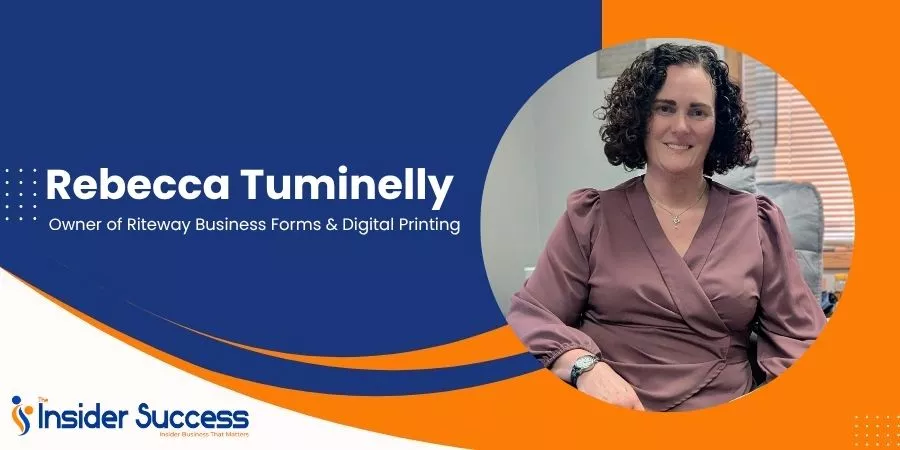
How a Healthcare Warrior Turned Pandemic Lessons into Print Industry Leadership!
Some careers follow a straight line. Others take the kind of unexpected turn that, in hindsight, feels like it was always meant to happen.
Rebecca Tuminelly’s path from healthcare professional to business owner is exactly that kind of story. It does not fit neatly into a conventional leadership narrative. There was no MBA roadmap, no family business handed down, no industry insider advantage. What there was instead was a woman who had spent years showing up for patients in their most vulnerable moments, who had navigated one of the most brutal healthcare crises in modern history, and who emerged from that experience knowing, with absolute clarity, that it was time for something new.
Today, as the owner of Riteway Business Forms and Digital Printing in Shoreview, Minnesota, Rebecca leads with the same precision, patience, and people-first instinct that defined her years in clinical care. She has brought something the print industry rarely sees into her workplace, the quiet, steady strength of someone who has genuinely been tested and chosen to grow from it.
Her journey also reflects the importance of developing strong leadership capabilities as professionals move into higher-responsibility roles. For a broader look at the skills required to lead high-performing teams, explore our guide to Modern Leadership Skills.
As one of 2026’s most transformational women leaders making an impact, Rebecca Tuminelly is not just running a business. She is redefining what leadership in a traditional industry can look like when it is guided by empathy, education, and an unshakeable sense of purpose.
The Pandemic, The Turning Point, and The Courage to Walk a New Path
There are decisions that change everything. For Rebecca, that decision came in the aftermath of working through the early stages of COVID-19 at a dedicated pandemic hospital.
The weight of those months was real and lasting. The emotional toll of frontline healthcare work during that period touched every professional who lived it, and Rebecca was honest enough with herself to recognise what it had cost her. Returning to bedside care no longer felt like the right path forward. She needed space to heal, to reflect, and to reimagine what the next chapter of her life could look like.
Buying a business was not an impulsive leap. It was a considered, courageous decision made by someone who had spent years being quietly encouraged toward leadership by the colleagues and coworkers who saw something in her that she was still learning to fully claim for herself.
The search process itself became part of her healing. It gave her time to think deeply, not just about what kind of business to buy, but about what kind of owner and leader she genuinely wanted to become. That intentionality, that willingness to pause and reflect before acting, is something that continues to shape how she leads Riteway today.
Precision Is Precision, Whether You Are Saving Lungs or Saving Print Jobs
To anyone unfamiliar with Rebecca’s story, the jump from Chronic Pulmonary Disease Educator to printing company owner might seem like one of the more unlikely career pivots imaginable.
But spend five minutes listening to her talk about both worlds and the connection becomes surprisingly clear.
Respiratory care is a discipline built on precision. Machines must be carefully calibrated. Measurements must be exact. If equipment is even slightly off, a patient feels it immediately. The margin for error is not just professionally unacceptable. In many cases, it is genuinely dangerous.
Printing, Rebecca discovered, operates on the same unforgiving logic.
That understanding, born not in a print shop but in a clinical setting, gave Rebecca an instinctive respect for process and teamwork that many industry newcomers take years to develop. She arrived already knowing that precision is not a preference. It is the foundation everything else rests on.
The steepest learning curve was undeniably the technical side of the business. Printing is far more intricate than most people realise from the outside. But Rebecca approached that learning curve the same way she approached complex patient cases. With curiosity, humility, and a genuine willingness to ask questions and listen carefully to the people who knew more than she did.
Collaboration Is Not a Soft Skill. It Is a Business Strategy.
Walk into Riteway and you will notice something that does not always come standard in manufacturing and print environments.
People talk to each other. Really talk.
Rebecca built her leadership philosophy in hospital corridors and patient education programs where collaboration was not a cultural nicety but a clinical necessity. The best outcomes for patients came when every voice in the room was heard, when assumptions were challenged, and when the person closest to the problem was trusted to help shape the solution.
She brought that exact philosophy into the print shop.
When a paper order is delayed and a job still needs completing, Rebecca does not make that call in isolation. She talks to the pressman. She asks the team. She draws on the experience that lives in the hands and minds of the people who work alongside her every day.
The results speak for themselves. Better decisions. Stronger print jobs. Happier customers. And a team that increasingly feels not just employed but genuinely invested in the outcomes they help shape.
Building a Team That Actually Wants to Show Up
One of the most telling signs of a leader’s real impact is what happens in the spaces between the work.
When Rebecca first introduced group activities at Riteway, birthdays, holiday gatherings, small shared moments designed to bring the team together, the response was not immediately enthusiastic. There was resistance. Some hesitation. The natural friction that comes when a workplace culture begins to shift.
But she stayed consistent. She kept showing up for those moments and kept making space for them, not as forced fun, but as a quiet, steady signal that this was a place where people mattered beyond their output.
The shift happened gradually and then unmistakably. Team members began asking when the next activity was planned. The expectation of participation became something the team itself started to hold, not because they were told to, but because they had experienced firsthand what it felt like to belong to something connected.
That transformation, quiet as it is, says everything about Rebecca’s leadership style. She does not manufacture culture through policy. She grows it through patience, presence, and genuine care.
Being Taken Seriously, The Challenge Nobody Warns You About
Leading in a traditionally male-dominated industry carries its own particular set of challenges. Rebecca speaks about this with characteristic directness.
The biggest obstacle has not been technical knowledge or business acumen. It has been the subtler, more exhausting work of establishing credibility in spaces where it is not automatically extended.
Being taken seriously. Demonstrating expertise in a room that is still adjusting to her presence. Proving, sometimes repeatedly, that she knows exactly what she is doing.
What has carried her through that challenge is a combination of her own growing confidence and the generosity of industry peers who chose to be genuinely supportive. People who answered her questions honestly, shared their knowledge freely, and helped her build the kind of deep industry understanding that commands respect on its own terms.
She carries her background in adult education into this space as well. An understanding that everyone learns differently, that people carry different strengths and different gaps, and that the most effective leaders are the ones who can see those differences clearly and build around them thoughtfully.
Print Is Alive. Rebecca Is Proving It.
In a world that has spent two decades being told that digital would make print obsolete, Rebecca Tuminelly is making a different argument. Not with words alone, but with the work coming out of Riteway every single day.
She sees herself as an advocate now, just a different kind than she was in healthcare. Where she once championed patients navigating chronic illness, she now champions an industry that has been too easily dismissed.
The capabilities of modern printing would have been almost unimaginable three decades ago. The textures, the finishes, the precision, the creative possibilities. Rebecca wants businesses to understand that a well-crafted, tangible piece of print marketing cuts through digital noise in ways that a screen simply cannot replicate.
Her vision for Riteway by the end of 2026 is not just growth in numbers. It is growth in meaning. A business recognised for expanding what print can do, for being a genuine resource for businesses seeking creative, tangible marketing solutions, and for proving that an industry written off by many is, in the right hands, very much still writing its best chapters.
Beyond the Business, The Woman Who Leads It
When the press runs stop and the workday ends, Rebecca Tuminelly is someone who loves her family deeply, dotes on her cats, finds grounding in music, both listening and playing, and spends quiet hours sewing. Her significant other, her people, her animals, these are the anchors that keep her centred in her purpose.
She carries a message for her younger self. The office manager at the blueprint company. The trade show coordinator still finding her footing.
And perhaps most beautifully, she carries a truth that her journey has taught her about life itself.
That is the quiet philosophy behind everything Rebecca has built at Riteway. Not perfection. Not fearlessness. Just the willingness to keep learning, keep growing, and keep showing up, for her team, her customers, her community, and herself.
That, in 2026 and always, is what transformational leadership truly looks like.