


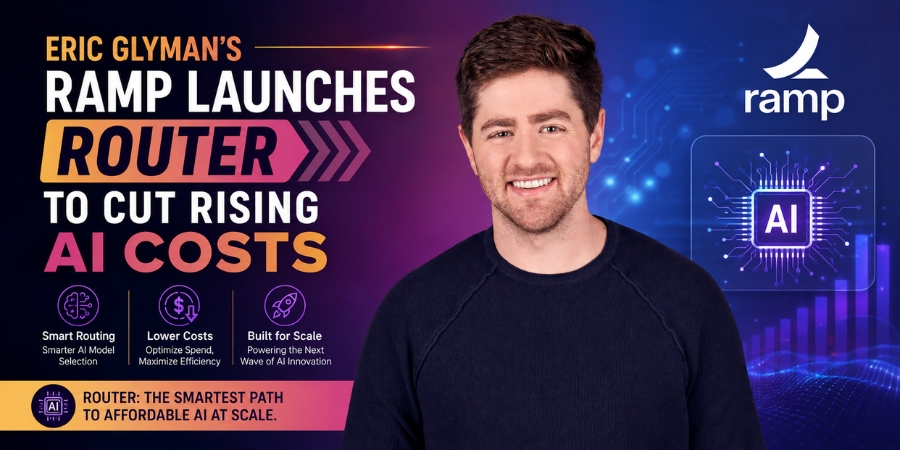
Eric Glyman is leading Ramp into a new phase of AI infrastructure as the financial operations company launches Router.com, a service designed to reduce the cost of using artificial intelligence models. Announced on August 19, 2026, Router gives developers a single endpoint for accessing major AI models and automatically directs each request to the lowest-cost model that meets the required performance level.
The launch expands Ramp’s involvement in AI beyond financial-management software and into the infrastructure used to operate AI applications. Ramp said customers already using Router have reduced inference costs by an average of 40%, while the service is available now and free through the end of 2026.
Eric Glyman’s Ramp targets a growing AI expense
For Eric Glyman and Ramp, the product addresses a problem that has become increasingly visible as businesses deploy more AI: the cost of processing AI requests can vary significantly depending on which model handles the task.
Ramp said its AI Index shows AI spending among its customers has increased 20.7 times since June 2025. The company argues that different tasks do not necessarily require the same model, creating an opportunity to reduce spending by matching requests with models based on performance and price.
Rather than requiring developers to select individual models for every request, Router is designed to make that decision automatically. This allows applications to use multiple AI providers through a common interface.
How Eric Glyman’s Ramp Router works
Router connects developers to models from companies including OpenAI, Anthropic and SpaceXAI, with Gemini listed as coming soon. It also supports leading open models, including Nvidia, Kimi, DeepSeek, GLM and Qwen, through infrastructure providers such as Fireworks AI. Ramp said additional providers are also expected to be added.
The system evaluates requests and selects the least expensive model that satisfies the developer’s quality requirements. Ramp also built automatic fallback capabilities intended to keep requests moving when a provider experiences a failure.
The company said Router includes more than 100 optimizations covering areas such as model selection, caching, compression, timing and request handling. Developers can use Ramp’s default routing strategy or configure their own approach. Developers can learn more about the platform through Ramp’s official Router page.
Ramp built the technology internally before opening it up
Eric Glyman’s Ramp did not develop Router solely as an external product. According to Ramp, the company built its internal model-routing system three years ago to control its own AI expenses.
Ramp said the internal system helped reduce its inference costs by approximately 30% for the same output while maintaining more than 99.9% reliability across production traffic. The company has now turned that internal technology into Router.com for outside developers.
Ramp is also using its own engineering work to determine which models perform best for particular workloads. The company developed Ramp SWE-Bench, a benchmark based on production engineering tasks, to evaluate models according to both performance and cost.
That approach reflects a broader shift in how companies evaluate AI systems. Instead of choosing a model simply because it leads a public benchmark, organizations can assess whether a particular model delivers sufficient quality for a specific business task at an acceptable price.
Why the Router launch matters for Ramp
The Router launch gives Eric Glyman’s Ramp another position in the rapidly expanding AI spending ecosystem. As more businesses adopt AI-powered workflows and automation, the one-person AI agency business model is also gaining attention. The company has already introduced AI-focused products for finance teams, including AI Token Spend Management, which helps businesses track and control spending across AI providers.
Ramp’s broader strategy has increasingly connected financial management with AI operations. In June, the company also launched Applied AI Solutions to help enterprises deploy AI agents across finance workflows.
The company’s expansion comes after a major funding milestone. In June 2026, Ramp announced a $750 million financing round that valued the company at $44 billion. Ramp said the funding would support its continued expansion, including its AI efforts.
For Eric Glyman, Router therefore represents more than another AI feature. It places Ramp directly in the infrastructure layer that helps businesses decide how AI requests are processed and how much those requests cost.
This news has been compiled using information gathered from various platforms and is intended for general informational purposes only.