


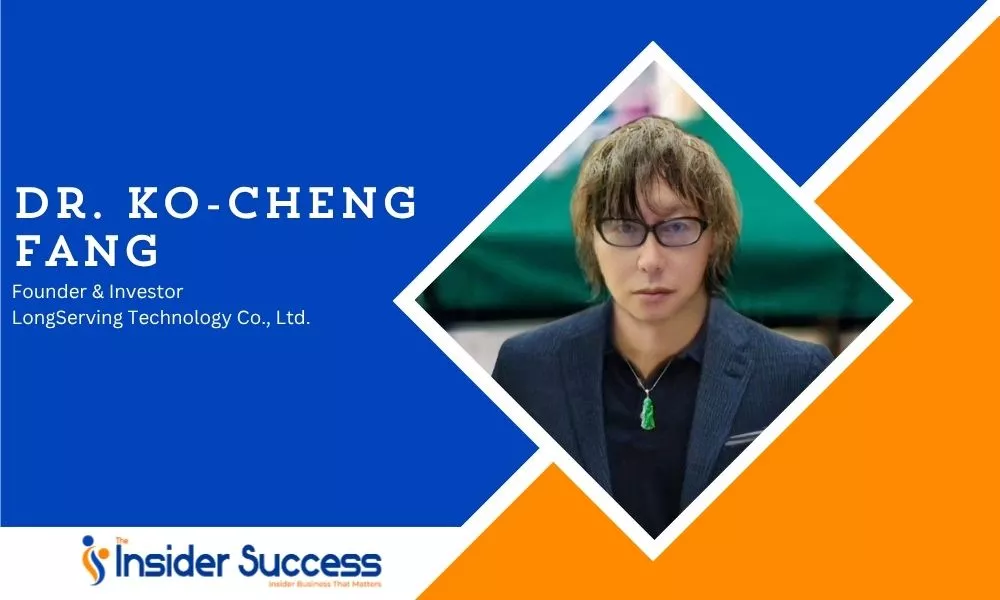
The Man Rewriting the Physics of Intelligence
Enterprise technology is advancing fast. Artificial intelligence is scaling, systems are becoming more powerful, and expectations continue to rise. But very few people are asking a more fundamental question: Is the foundation itself ready for what comes next?
Dr. Ko-Cheng Fang is one of them.
While much of the industry focuses on improving silicon, refining algorithms, and expanding data infrastructure, Dr. Fang is taking a different approach, rethinking how computation should work at its core. As the Founder, Chairman, and CEO of LongServing Technology in Taipei, he is working at the intersection of physics and intelligence, exploring the shift from electronic systems to photonic quantum computing.
For him, this is not just another phase of innovation. It is a necessary evolution.
From Passion to Purpose: The Origin of a Visionary
Every transformative journey begins with a deeply personal conviction. For Dr. Fang, that conviction is rooted in passion, not the kind that fades with trends, but the kind that persists through failure, skepticism, and time.
He believes that true innovation is born not from convenience, but from persistence through difficulty. His early pursuits, whether in materials science or artistic expression, reflect a mindset driven by curiosity and endurance. Long before founding LongServing Technology, Dr. Fang had already demonstrated an ability to challenge what others considered impossible, from developing laboratory-grown jadeite to creating foundational patents in cloud security systems later adopted by global institutions.
This fusion of creativity and scientific rigor would later define his approach to enterprise technology, where logic meets imagination, and invention becomes a form of art. This approach reflects how innovation and technology are increasingly shaping the future of intelligent solutions. This approach reflects how innovation and technology are increasingly shaping the future of intelligent solutions.
The Limits of Silicon and the Rise of Light
The modern digital economy is built on electronic chips. From cloud infrastructure to AI models, everything depends on electrons moving through circuits. But according to Dr. Fang, this model is approaching its limits.
Electronic computation is inherently constrained by physics, heat generation, energy consumption, and electromagnetic interference. As AI systems grow more complex, these limitations are no longer theoretical, they are operational challenges affecting scalability, cost, and sustainability.
Dr. Fang’s response is both simple and revolutionary: replace electrons with photons.
Unlike electrons, photons travel at the speed of light and are unaffected by electromagnetic interference. This allows for dramatically higher computational speeds and far lower energy consumption. While mainstream discussions around photonic computing often focus on incremental improvements, Dr. Fang’s vision goes much further.
According to his research, photonic computing systems could achieve at least 1,000× the performance of traditional electronic CPUs and potentially up to at least 10,000× at full maturity.
This is not just an upgrade. It is a complete paradigm shift.
X-Photon Technology: Engineering the Impossible
Dr. Ko-Cheng Fang has developed a breakthrough 2nm photonic quantum material designed to overcome the physical limitations of traditional electronic chip miniaturization and advance the future of photonic computing.
The core innovation of this unprecedented material lies in its ability to compress light wavelengths to an average of just 2 nanometers — entering the X-ray shortwave spectrum. For this reason, the material was named “X-Photon.”
Using advanced analytical techniques such as Raman spectroscopy and X-ray diffraction, researchers were unable to identify any known crystal structure associated with the material. These findings suggest that X-Photon may represent an entirely new category of photonic quantum material previously unknown in nature. This is significant.
Traditional silicon photonics operates at wavelengths between 1300–1500 nanometers, creating a mismatch with modern semiconductor architectures that function at much smaller scales. Because the wavelength of silicon photonics is far larger than the 14nm copper interconnect linewidth used inside advanced chips, silicon photonics can only be applied to data transmission rather than on-chip computation.
Dr. Fang’s X-Photon technology eliminates this barrier.
X photon is designed to enable nanoscale photonic pathways and photonic transistors for next-generation photonic computing chips. This is not merely a breakthrough—it is a Nobel Prize-level invention of profound scientific significance. This allows photonic chips (photonic CPU/photonic GPU) to function not as experimental alternatives, but as practical replacements for existing CPUs, even within smartphones and personal devices.
In addition to photonic chips, LongServing Technology is also developing its own photonic memory. By combining photonic chips with photonic memory, overall computational speed can be significantly enhanced—reaching at least 10,000 times faster than current electronic CPUs. The foundation of this breakthrough lies in X-Photon materials; without this material, such advancements would not be possible for humanity. In essence, LongServing Technology is not adapting to the future of computing, it is defining it.
Beyond Speed: Redefining Efficiency and Sustainability
While performance gains are impressive, the true impact of photonic computing lies in its efficiency.
Today’s data centers consume enormous amounts of energy, often comparable to entire cities. As AI adoption accelerates, this demand is expected to grow exponentially, raising serious concerns about environmental sustainability.
Photonic chips offer a fundamentally different approach.
By reducing reliance on electrical conduction and minimizing heat generation, they dramatically lower energy consumption. When combined with emerging photonic memory systems, another area of development at LongServing Technology, the need for repeated signal conversion is significantly reduced, further enhancing efficiency.
For Dr. Fang, this is not just a technological advantage, it is a responsibility.
He views photonic computing as a critical step toward building a more sustainable digital infrastructure, one capable of supporting the next generation of AI without compromising the planet.
Correcting the Narrative: Challenging Industry Assumptions
Despite its potential, photonic computing is often misunderstood.
Many existing analyses, particularly those generated by AI models, are based on outdated assumptions rooted in silicon photonics. Dr. Fang has actively worked to correct these misconceptions, emphasizing that LongServing’s approach represents a fundamentally different technological framework.
For example, the widely cited claim that photonic CPUs are “500× faster” than electronic chips significantly underestimates their true potential. According to Dr. Fang, real-world performance gains are far greater, achieving computing speeds at least thousands of times faster.
Similarly, the assumption that photonic chips are limited to data centers is incorrect. LongServing’s vision is far more expansive: to replace electronic CPUs across all computing environments, from enterprise systems to personal devices.
This willingness to challenge prevailing narratives is part of what defines Dr. Fang’s leadership.
Building LongServing Technology: A Multi-Dimensional Vision
LongServing Technology operates across multiple disciplines, including semiconductors, materials science, biotechnology, and design.
This cross-disciplinary approach reflects a simple belief: innovation does not happen in isolation.
From enterprise security systems to advanced materials research, the company’s work is unified by a single objective, building the foundation for the next generation of intelligent systems.
Leadership Beyond Convention
Dr. Fang’s leadership is defined by clarity and long-term thinking.
Rather than chasing visibility or short-term wins, he focuses on ideas that can sustain relevance over time. He values depth over speed, and coherence over trends.
For him, leadership is not about control, it is about enabling meaningful progress.
The Next Frontier: AI, Robotics, and Intelligent Systems
As artificial intelligence evolves, its growth is increasingly limited by hardware capabilities.
Dr. Fang sees photonic computing as the key to unlocking the next stage, enabling systems that operate at greater speed, scale, and efficiency.
This extends beyond AI into robotics and intelligent systems that can integrate seamlessly into industries and everyday life.
What defines this future is not just smarter systems, but systems built on stronger foundations.
A Global Call for Collaboration (Rewritten)
LongServing Technology has announced a significant breakthrough in photonic chip manufacturing, marking a potential turning point in the future of next-generation computing.
According to the company, it has successfully developed proprietary equipment and core manufacturing processes independent of conventional semiconductor technologies, eliminating the need for traditional lithography systems, etching equipment, and photoresist-based manufacturing methods.
The breakthrough positions LongServing Technology to independently develop and manufacture photonic CPUs and photonic memory, while advancing an integrated photonic computing architecture projected to deliver performance exceeding traditional electronic CPUs by more than 10,000 times.
The company is also moving forward with plans to establish a photonic chip demonstration facility in Taiwan, aiming to create a global center for advanced photonic technologies and next-generation computing infrastructure.
LongServing Technology is currently seeking strategic partners in photonic IC design, optical-electrical conversion technologies, and related advanced components as it accelerates development of its photonic computing ecosystem.
Redefining What It Means to Be an AI Titan (Rewritten)
In an industry driven by speed and competition, Dr. Fang’s approach stands apart.
He is not focused on being first.
He is focused on building what lasts.
Recognized among The AI Titans of Enterprise Technology in 2026, his work extends beyond artificial intelligence. It addresses the underlying systems that make intelligence possible.
His vision centers on creating technology that is scalable, sustainable, and aligned with long-term human needs.
This is not about incremental improvement.
It is about redefining the foundation.
Legacy: Building What Endures (Rewritten)
For Dr. Fang, legacy is not defined by recognition, it is defined by responsibility.
Responsibility to push scientific boundaries. Responsibility to build technology that serves future generations. Responsibility to ensure innovation creates meaningful impact.
He is less concerned with visibility and more focused on durability, systems that continue to function, evolve, and contribute over time.
Because in the end, the true measure of innovation is not what is created today, but what continues to work tomorrow.