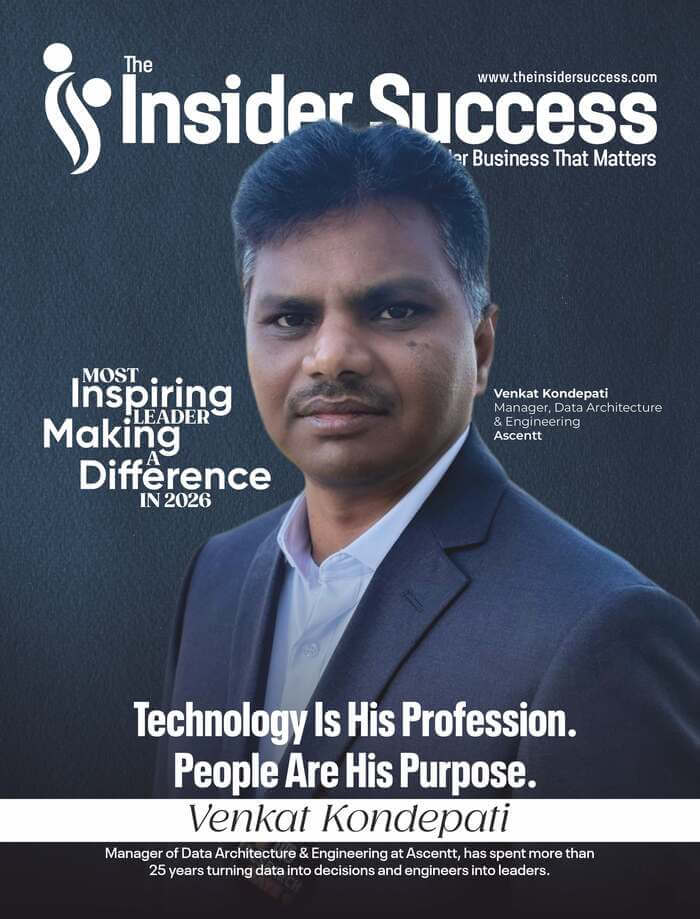


Venkat Kondepati, Manager of Data Architecture & Engineering at Ascentt, has spent more than 25 years turning data into decisions and engineers into leaders.
Every career has a first project. Venkat Kondepati’s was a map of pipes and power lines.
In 2001, he began as a CAD/GIS Engineer on utility and infrastructure mapping projects, and he soon noticed that the real challenge was not building software. It was helping organizations make better decisions. That insight has guided a career of more than 25 years across GIS, data engineering, cloud architecture, cybersecurity, customer identity and access management, and artificial intelligence.
He spent more than fifteen years at S&P Global leading GIS, cloud, identity, DevSecOps, SRE, and data engineering initiatives. He led more than 60 application migrations, optimized more than 50 Snowflake accounts, and led initiatives contributing to more than $1.2 billion in business impact. Today, at Ascentt in Plano, Texas, he is building intelligent data ecosystems that combine AI, cloud-native architecture, real-time analytics, and spatial intelligence, systems designed not just to report what happened, but to reason and act.
That thinking is captured in the V.E.N.K.A.T Framework, his model for building enterprise data platforms for the era of agentic AI. It rests on six pillars: Verified Data, Event-Driven Architecture, Native Spatial Intelligence, Knowledge Graphs, AI Orchestration, and Trust and Governance.
Yet when he talks about impact, he looks past the numbers. He points to the engineers he mentored who grew into leaders, and to NexaMap, the open-source GIS platform he founded so that students, educators, and professionals can learn geospatial technology without expensive software or enterprise infrastructure. Lightweight and low-bandwidth, it combines modern web technologies, geospatial analytics, and AI-assisted capabilities, and it was built to democratize GIS education.
He is a former Member Leader of the Data Engineering Group within Forbes Technology Council, an IEEE Senior Member, a mentor at The University of Texas at Dallas and on Topmate, an industry judge, and a reviewer for technical publications. His mission is simple: use technology as a force for empowerment, innovation, and positive change.
In the conversation that follows, he explains why cloud migrations fail, why identity is the new security perimeter, why data platforms are becoming decision platforms, and why technology became his profession but empowering people became his purpose.
The Leader’s Origin – 20 Years in the Making
What was the moment 20 years ago that set you on the path of technology leadership and when did you first realize you were building something far bigger than a career?
My journey began in 2001 as a CAD/GIS Engineer working on utility and infrastructure mapping projects. At the time, I was fascinated by technology, but I quickly realized that the real challenge wasn’t building software, it was helping organizations make better decisions. Working with geospatial and engineering data taught me that information becomes valuable only when it can drive action.
As my career evolved through GIS, software development, cloud architecture, cybersecurity, data engineering, and AI, my perspective expanded. I moved from solving technical problems to solving business problems through technology. The moment I realized I was building something bigger than a career came when I started mentoring engineers and watching them grow into leaders themselves.
That realization inspired me to contribute beyond my corporate responsibilities. It eventually led me to create NexaMap, an open-source GIS platform designed to make geospatial technology more accessible to students and professionals worldwide. Technology became my profession, but empowering people and creating opportunities became my purpose.
You have delivered $1.2B+ in measurable impact across your career. What does that number actually represent to you beyond the dollar figure?
The $1.2 billion figure represents trust more than revenue.
It reflects the confidence organizations placed in me and my teams to modernize platforms, lead enterprise transformations, and deliver technology that millions of users depend on every day. Behind every dollar is a customer experience improved, a business process streamlined, a risk mitigated, or a decision accelerated.
However, the number only tells part of the story. It also represents the collective effort of hundreds of engineers, architects, product managers, and business leaders who worked together toward a common vision.
What matters most to me is the impact that cannot be measured on a balance sheet. The engineers who became leaders, the teams that learned to innovate differently, and the organizations that transformed their culture are the outcomes I value most. Revenue is measurable; human growth and leadership development are not.
Moving from Director at S&P Global to Manager of Data Architecture & Engineering at Ascentt, what drove that decision, and what are you building there that excites you most right now?
The move was never about title, it was about impact and innovation.
After spending more than fifteen years leading GIS, cloud, IAM, DevSecOps, SRE, and data engineering initiatives at S&P Global, I wanted to be closer to the emerging convergence of AI, geospatial intelligence, and next-generation data platforms.
Ascentt provided an opportunity to help shape that future. Today, I am focused on building intelligent data ecosystems that combine AI, cloud-native architectures, real-time analytics, and spatial intelligence to solve complex business challenges.
What excites me most is the opportunity to move beyond traditional reporting and analytics into systems that can predict, reason, and act. Whether it’s digital twins, supply chain optimization, manufacturing intelligence, or Agentic AI, we are creating solutions that transform data into decisions. I believe we are entering an era where data platforms will become decision platforms, and being part of that transformation is incredibly energizing.
Cloud, Data, and the Architecture of the Future
You have led over 60 application migrations and major cloud transformations like EDIN 7.0 and Bladerunner. What is the biggest mistake organizations make when they approach cloud migration?
The biggest mistake is treating cloud migration as a technology project instead of a business transformation.
Many organizations focus on moving applications quickly without rethinking architecture, processes, security models, or operating practices. As a result, they simply move technical debt from one environment to another.
Successful cloud transformations start with business outcomes. Are we improving resilience? Accelerating innovation? Reducing costs? Enabling AI? The migration strategy should support those objectives.
Another common mistake is underestimating the cultural shift required. Cloud requires automation, DevSecOps, platform engineering, FinOps, and shared ownership. Without these changes, organizations rarely achieve the full value of their investment.
Technology is only one part of transformation. People, processes, and culture determine whether migration becomes a strategic advantage or simply an infrastructure relocation.
You reduced costs by 70% and cut processing times by 90% for enterprise clients. What is the strategic thinking behind results at that scale that most technology leaders miss?
Many leaders focus on optimizing technology. The real opportunity is optimizing outcomes.
Transformational results rarely come from selecting a better tool. They come from challenging assumptions, eliminating complexity, and redesigning how value is delivered.
Instead of asking, “How do we make this faster?” I often ask, “Why are we doing this in the first place?” That shift in thinking frequently reveals opportunities to simplify, automate, or eliminate entire processes.
Another factor is platform thinking. Building reusable capabilities that serve multiple teams creates exponential value compared to solving one problem at a time.
Finally, investing in people matters just as much as investing in technology. Technology scales systems. Leadership scales capability. When teams are empowered, aligned, and focused on business outcomes, extraordinary results become achievable.
You have optimized 50+ Snowflake accounts and architected platforms across AWS, Azure, and GCP. What does a truly future-proof data architecture actually look like?
A future-proof architecture is not defined by a platform. It is defined by principles.
It starts with trusted data, governance, ownership, and quality. Without those foundations, AI and analytics become unreliable.
It embraces event-driven design and real-time intelligence rather than relying solely on batch processing. It supports multi-cloud flexibility, open standards, and reusable data products.
Most importantly, it must be AI-ready. Future architecture needs semantic layers, knowledge graphs, vector search, and intelligent governance frameworks that support both humans and AI agents.
I also believe spatial intelligence will become a core component of enterprise architecture. Most business events happen somewhere, yet location remains underutilized. The organizations that combine trusted data, spatial context, and AI will create the next generation of intelligent enterprises.
You embedded GenAI into enterprise data ingestion and delivery. Where do you see Agentic AI and RAG reshaping data engineering in the next three years?
I believe we are moving from Data Engineering to Decision Engineering.
Agentic AI will automate many operational aspects of data platforms, including monitoring, anomaly detection, lineage analysis, documentation, and workflow orchestration. Engineers will spend less time managing pipelines and more time designing intelligent systems.
RAG will become the interface between people and enterprise knowledge. Instead of searching dashboards and documentation, users will interact conversationally with trusted organizational knowledge.
The biggest transformation will come from combining real-time events, knowledge graphs, and AI reasoning. Systems will evolve from answering “What happened?” to answering “Why did it happen?” and “What should happen next?”
Organizations that embrace this shift will gain a significant competitive advantage in speed, insight, and decision-making.
Security, Teams, and Leadership
You led enterprise-wide Identity and Access Management across Okta, ForgeRock, SailPoint, and CyberArk. Why is Customer IAM still the most underestimated risk in enterprise technology today?
Identity has become the new security perimeter.
Most organizations continue to focus heavily on infrastructure security while underestimating identity. Yet every digital interaction begins with authentication and authorization.
Customer IAM impacts security, compliance, customer experience, and revenue. When it works well, nobody notices. When it fails, the consequences can be severe.
The challenge is becoming even greater as organizations introduce AI agents, APIs, service accounts, and autonomous workflows. We are moving into a world where non-human identities may outnumber human users.
The future of cybersecurity will increasingly depend on identity governance. In many ways, IAM is no longer just a security function; it has become a core business capability.
You built and scaled DevSecOps and SRE functions globally. What does a high-performing engineering organization look like at its core, and what breaks most teams before they ever get there?
High-performing organizations are built on alignment, ownership, and trust.
The best teams understand the business problems they are solving and take ownership of outcomes rather than tasks. They operate with clear goals, measurable objectives, and strong accountability.
What breaks most teams is misalignment. Development, operations, security, and business teams often operate with competing priorities. Silos create friction, slow decision-making, and reduce innovation.
The most successful organizations create shared ownership and empower teams to make decisions while remaining accountable for results.
Technology matters, but culture matters more. When teams trust each other, understand the mission, and focus on customer value, performance naturally follows.
You actively mentor at UT Dallas and Topmate. What is the one thing you tell every young technology professional that changes how they see their own potential?
I tell them: “Don’t let your current role define your future impact.”
Many people underestimate themselves because they focus on where they are today instead of where they could be in five or ten years.
I started as a GIS engineer and never imagined leading global technology organizations, contributing to industry thought leadership, or mentoring future leaders. What changed my trajectory wasn’t a perfect plan, it was continuous learning and curiosity.
This belief also inspired me to create NexaMap. I wanted students and aspiring professionals to have access to geospatial learning opportunities regardless of budget or geography.
Skills compound. Experience compounds. Relationships compound.
The people who succeed are not always the smartest. They are the ones who remain adaptable, curious, and willing to keep learning throughout their careers.
As a former Forbes Technology Council Member Leader and IEEE Senior Member, what responsibility does that platform carry for you personally
Recognition carries responsibility.
I view these platforms as opportunities to advance the profession, mentor future leaders, and contribute to responsible innovation.
Technology is evolving rapidly, especially with AI. Leaders have a responsibility to help organizations separate sustainable innovation from hype and ensure emerging technologies are implemented ethically and responsibly.
I also believe strongly in giving back. Throughout my career, mentors invested time in helping me grow. Today, I try to do the same through mentoring, speaking engagements, writing, judging, and community involvement.
The true value of influence is not visibility. It is the ability to create opportunities and positive impact for others.
You have led cross-functional teams across multiple continents and cultures. What is the leadership principle that has never failed you, regardless of the team or the challenge?
The principle that has never failed me is simple: lead with trust but verify through outcomes.
People perform at their best when they feel trusted, respected, and empowered. Micromanagement limits creativity and ownership. Trust unlocks both.
However, trust does not eliminate accountability. Clear goals, measurable outcomes, and transparency are essential.
Across cultures, industries, and organizations, I have found that people consistently respond to leaders who provide clarity, remove obstacles, and genuinely invest in their success.
Technology changes. Markets change. But people thrive when they feel valued and trusted. That principle has remained constant throughout my career.
Vision, Legacy, and Impact
The intersection of GenAI, cloud-native platforms, and real-time data delivery is reshaping every industry. Where is the most significant opportunity hiding that the technology world has not yet fully recognized?
The biggest opportunity is not better AI models.
It is transforming enterprises from systems of record into systems of action.
Most organizations have become very good at collecting and analyzing data. Far fewer can transform insights into immediate decisions and automated outcomes.
The future belongs to organizations that combine real-time events, enterprise knowledge, AI reasoning, workflow automation, and spatial intelligence into a continuous decision loop.
This conviction is one reason I created NexaMap. Through that initiative, I have explored how geospatial intelligence, AI, and open technologies can work together to make advanced analytics more accessible.
The next wave of value creation will come from systems that can sense, understand, reason, act, and continuously learn.
You are being recognized as one of the Most Inspiring Leaders Making a Difference in 2026. What does making a genuine difference mean to you, and what is the impact you are most proud of that no award or metric will ever fully capture?
Making a genuine difference means leaving people, organizations, and communities stronger than they were before I arrived.
Technology has always been my profession, but people have always been my purpose.
Throughout my career, I have helped build platforms, modernize systems, and lead transformations. Yet the impact I am most proud of cannot be measured in revenue, uptime, or project milestones.
One example is NexaMap, an open-source GIS platform created to democratize access to geospatial technology education. While enterprise platforms may contribute millions of dollars in business value, NexaMap represents something equally meaningful: the opportunity to help students, educators, and aspiring professionals learn, innovate, and build their futures.
Awards recognize accomplishments. Metrics measure outcomes.
But helping someone gain confidence, discover their potential, or become a leader is an impact that no dashboard can capture. If my work has empowered others to create positive change of their own, then that is the legacy I value most.