


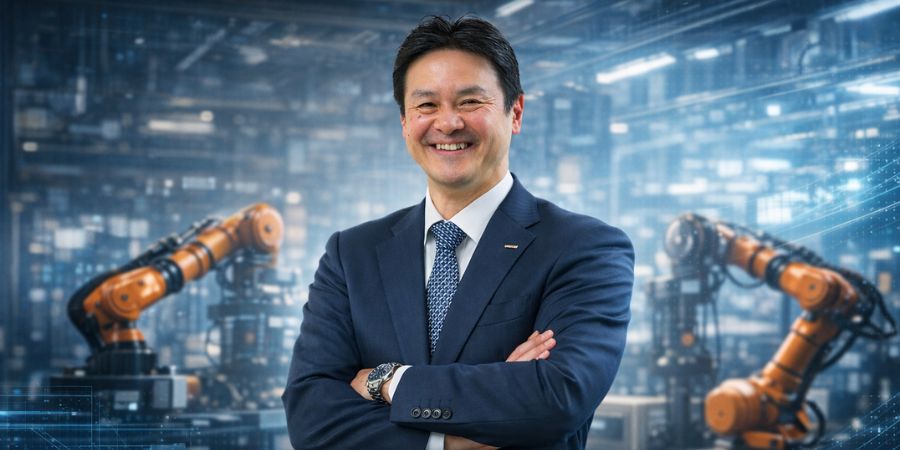
Junta Tsujinaga, President and CEO of OMRON Corporation, officially launched the company’s “Shaping the Future 2030” industrial roadmap, outlining a long-term strategy to accelerate digital transformation across global manufacturing industries.
The announcement positions OMRON as more than a traditional automation hardware provider. Under Tsujinaga’s leadership, the company aims to evolve into a Digital Transformation (DX) partner, supporting manufacturers in integrating advanced automation, data intelligence, and smart factory technologies.
The roadmap has quickly gained attention across the industrial technology sector, where Tsujinaga’s “GEMBA DX” strategy has become one of the most discussed digital transformation initiatives in manufacturing.
The Vision Behind “Shaping the Future 2030”
The Shaping the Future 2030 roadmap represents OMRON’s long-term commitment to transforming how factories operate. The strategy focuses on combining automation hardware with software, data analytics, and AI-driven insights.
According to Tsujinaga, the future of manufacturing lies in digitally connected production environments, where machines, data systems, and workers collaborate seamlessly.
Through the roadmap, OMRON plans to expand its role in enabling smart factories, where operational data from the factory floor—commonly known as “GEMBA” in manufacturing terminology—can be analyzed and optimized in real time.
This approach aims to improve productivity, reduce operational downtime, and enable manufacturers to make faster data-driven decisions.
Why the GEMBA DX Strategy Is Trending
The announcement has sparked significant discussion in the manufacturing sector, primarily because of the GEMBA DX (Digital Transformation at the factory floor) concept introduced by Tsujinaga.
GEMBA DX focuses on connecting physical factory operations with digital intelligence systems. Rather than selling standalone hardware, OMRON’s approach integrates sensors, robotics, controllers, and cloud analytics into a unified ecosystem.
Industry analysts say this strategy aligns with the growing demand for Industry 4.0 solutions, where factories require not only automation equipment but also data-driven operational visibility.
As a result, searches related to industrial digital transformation strategies and GEMBA DX have surged among manufacturing professionals and technology leaders.
OMRON’s Shift from Hardware to Digital Transformation Partner
Historically, OMRON has been widely recognized for its leadership in industrial automation hardware, including sensors, controllers, and robotics systems.
However, under Tsujinaga’s leadership, the company is now focusing on value-driven digital solutions rather than purely hardware-based offerings.
The shift reflects a broader industry trend where manufacturing companies are seeking end-to-end technology partners capable of delivering both physical automation systems and digital platforms.
By positioning itself as a DX partner, OMRON intends to support manufacturers in areas such as:
-
Smart factory integration
-
Data-driven predictive maintenance
-
Real-time production optimization
-
AI-powered quality control
This strategic transition could strengthen OMRON’s competitive position in the rapidly evolving industrial technology landscape.
Industry Impact and Global Manufacturing Implications
The launch of the Shaping the Future 2030 roadmap arrives at a time when global manufacturers are under increasing pressure to improve efficiency, sustainability, and supply chain resilience.
Digital transformation initiatives are becoming critical for organizations looking to modernize production systems and remain competitive in global markets.
Experts believe OMRON’s focus on GEMBA DX could influence how other automation providers approach factory digitalization.
If successfully implemented, the roadmap may accelerate the adoption of AI, IoT, and data-driven manufacturing technologies across industries ranging from automotive and electronics to pharmaceuticals and logistics.
What Comes Next for OMRON’s 2030 Vision
With the Shaping the Future 2030 roadmap now officially launched, industry observers will be watching how OMRON executes its digital transformation strategy over the coming years.
The success of the GEMBA DX initiative will likely depend on how effectively the company integrates hardware, software, and data platforms into scalable solutions for global manufacturers.
As the manufacturing sector continues its shift toward smart factories and digital ecosystems, Tsujinaga’s strategy could play a key role in shaping the next phase of industrial innovation.
Read Also: Elon Musk xAI Founder Exodus Leaves Just 2 of Original 11 Today