


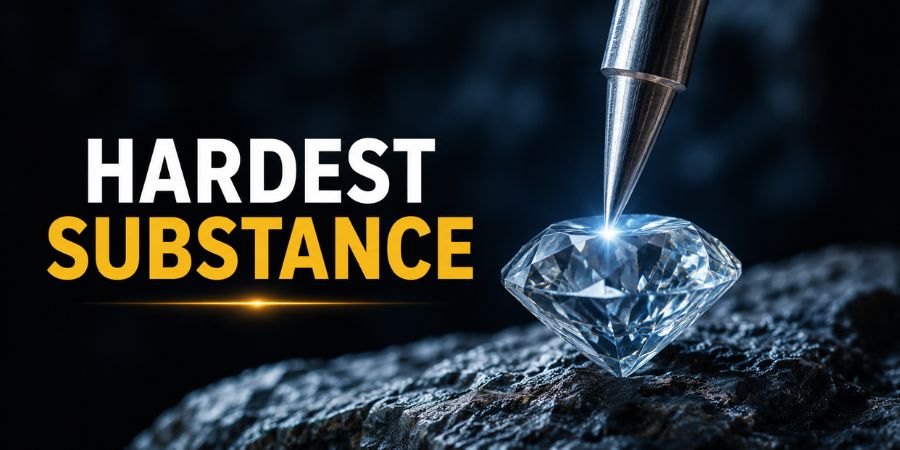
A tiny crystal no larger than a fingernail can slice through steel, survive brutal pressure, and shape industries worth billions of dollars. That reality alone explains why the debate around the hardest substance on earth never seems to disappear. Scientists, engineers, jewelers, and technology companies continue searching for materials that can outperform nature’s toughest creations. What once sounded like a simple science question has now evolved into a fascinating competition between natural minerals and advanced lab-made materials.
In 2026, the conversation is even more exciting because researchers are developing substances that challenge long-standing beliefs about strength, durability, and hardness. Understanding what is the hardest substance on earth is no longer just about diamonds. It is about discovering how modern science is redefining what “hard” and “strong” truly mean.
What Is the Hardest Substance on Earth?
The hardest substance on earth is traditionally considered to be diamond. Natural diamond ranks at the very top of the Mohs hardness scale with a score of 10, making it exceptionally resistant to scratching. This is why diamonds are widely used not only in jewelry but also in industrial cutting and drilling tools.
However, the answer becomes more complicated when scientists examine hardness under different conditions. Some newly engineered materials may outperform diamond in specific environments. That is why discussions around what is the hardest material on earth continue to evolve every year.
Hardness itself refers to a material’s resistance to scratching, indentation, or deformation. Many people confuse hardness with strength, but they are not exactly the same thing. A material can be incredibly hard yet still brittle enough to crack under pressure.
Understanding the Mohs Hardness Scale
The Mohs scale is one of the most widely used methods for measuring mineral hardness. Developed by Friedrich Mohs in 1812, the scale ranks materials from 1 to 10.
Here is a simplified breakdown:
- Talc – 1
- Gypsum – 2
- Calcite – 3
- Fluorite – 4
- Apatite – 5
- Feldspar – 6
- Quartz – 7
- Topaz – 8
- Corundum – 9
- Diamond – 10
Diamond sits alone at the top because it can scratch every other natural material. That unique property is one major reason why it remains associated with the strongest material in the world.
Why Diamond Is So Hard
The secret behind diamond’s incredible hardness lies in its atomic structure. Every carbon atom in a diamond forms extremely strong covalent bonds with four neighboring carbon atoms. This creates a rigid three-dimensional crystal lattice.
Because the atoms are packed together so tightly, separating them requires tremendous force. That is why diamond resists scratching better than nearly every naturally occurring substance.
Key Reasons for Diamond’s Hardness
- Extremely strong carbon-carbon bonds
- Dense crystal structure
- Uniform atomic arrangement
- High resistance to wear and scratching
This structure also explains why diamonds can maintain sharp cutting edges for industrial applications.
Is Diamond the Strongest Material in the World?
Here is where the conversation gets interesting. Although diamond is often called the strongest material in the world, scientists separate “hardness” from “strength.”
A diamond resists scratches exceptionally well, but it can still fracture if struck at the correct angle. In other words, diamond is hard but not always the toughest material.
Hardness vs Strength vs Toughness
These terms are frequently confused:
| Property | Meaning |
|---|---|
| Hardness | Resistance to scratching |
| Strength | Ability to withstand force |
| Toughness | Resistance to cracking or breaking |
So when people ask what is the strongest material on earth, the answer depends on which property they are measuring.
For example:
- Diamond = hardest natural material
- Graphene = among the strongest known materials by tensile strength
- Tungsten carbide = extremely durable industrial material
- Boron nitride = highly resistant under certain conditions
What Is the Strongest Material on Earth in 2026?
In 2026, many researchers consider graphene one of the strongest materials ever discovered. Graphene is a single layer of carbon atoms arranged in a hexagonal lattice. Despite being incredibly thin, it has astonishing tensile strength.
Why Graphene Is Extraordinary
Graphene is:
- Around 200 times stronger than steel
- Extremely lightweight
- Flexible
- Electrically conductive
- Thermally efficient
This has led many experts to call it the strongest material in the world for future technologies.
Still, graphene is not necessarily the hardest substance on earth because hardness and tensile strength are different measurements.
Materials That Compete With Diamond
Scientists continue experimenting with substances that may rival or exceed diamond in certain conditions.
Wurtzite Boron Nitride
This rare material forms during volcanic eruptions and may surpass diamond under extreme stress. Some theoretical studies suggest it could be harder than diamond when compressed.
Lonsdaleite
Often called hexagonal diamond, lonsdaleite forms from meteorite impacts. Researchers believe its unique crystal structure could potentially make it harder than standard diamond.
Aggregated Diamond Nanorods
These engineered structures are created in laboratories using high pressure and temperature. Some experiments show they may resist compression even better than natural diamond.
Graphene-Based Composites
While graphene itself is more associated with tensile strength, researchers are combining it with other materials to produce surfaces that are incredibly resistant to damage.
Natural vs Synthetic Hard Materials
One of the biggest developments in recent years is the rise of synthetic materials. Lab-created substances now compete directly with natural minerals.
Natural Hard Materials
Examples include:
- Diamond
- Corundum
- Quartz
- Topaz
Synthetic Hard Materials
Examples include:
- Cubic boron nitride
- Silicon carbide
- Synthetic diamond
- Advanced ceramics
Synthetic materials often offer better consistency and lower production costs for industrial use.
Industrial Uses of the Hardest Substance on Earth
The hardest material on earth is not valuable only because it looks beautiful. Industries rely heavily on ultra-hard materials for precision and durability.
Cutting Tools
Diamond-tipped tools are widely used for:
- Mining
- Construction
- Metal cutting
- Stone processing
Their hardness allows them to remain sharp for long periods.
Drilling Equipment
Oil and gas companies use diamond drill bits to penetrate dense rock formations deep underground.
Electronics
Synthetic diamond is increasingly important in advanced electronics because of its excellent thermal conductivity.
Medical Equipment
Ultra-hard materials are used in:
- Surgical tools
- Dental drills
- Precision cutting devices
Aerospace Applications
Modern aircraft and spacecraft components benefit from hard, lightweight materials that resist wear under extreme conditions.
Why Scientists Still Debate the Hardest Material on Earth
The question of what is the hardest material on earth is more complex than most people realize. Scientists measure hardness using several different techniques, including:
- Scratch resistance
- Indentation tests
- Compression resistance
- Elastic deformation
A material that dominates one category may not perform as well in another.
For example, diamond excels at scratch resistance but can lose to other materials in impact resistance or flexibility.
This is why no single answer completely settles the debate.
The Science Behind Superhard Materials
Superhard materials are generally defined as substances with hardness values exceeding 40 gigapascals.
Characteristics of Superhard Materials
They usually feature:
- Strong atomic bonding
- Dense crystal structures
- High compressive strength
- Resistance to heat and wear
Researchers constantly search for new atomic arrangements that could produce even tougher substances.
Can Anything Break a Diamond?
Surprisingly, yes.
Although diamond is the hardest substance on earth in terms of scratching resistance, it can still be damaged.
Ways Diamonds Can Break
- Sharp impacts
- Extreme pressure
- Specific fracture angles
- High temperatures in oxygen-rich environments
Diamonds possess cleavage planes where the crystal can split under force. This is why jewelers cut diamonds carefully using precise techniques.
The Role of Carbon in Super-Strong Materials
Carbon plays a major role in many of the world’s strongest substances.
Carbon-Based Materials
- Diamond
- Graphene
- Carbon nanotubes
- Fullerenes
Different atomic arrangements create dramatically different properties.
For example:
- Graphite is soft
- Diamond is extremely hard
- Graphene is incredibly strong
The difference comes entirely from how carbon atoms bond together.
What Makes a Material Truly Strong?
When scientists discuss the strongest material in the world, they usually evaluate multiple factors together.
Important Strength Factors
- Tensile strength
- Compression resistance
- Elasticity
- Durability
- Heat resistance
- Impact resistance
Real-world applications often require balancing all these properties rather than maximizing only one.
Hardest Natural Materials on Earth
Here are some of the toughest naturally occurring substances known today.
Diamond
Still considered the hardest naturally occurring material.
Corundum
This mineral includes rubies and sapphires. It ranks 9 on the Mohs scale.
Moissanite
Originally discovered in meteorites, moissanite is extremely hard and commonly used as a diamond alternative.
Quartz
Widely used in electronics and construction due to its durability.
Strongest Synthetic Materials in 2026
Human innovation has produced some remarkable artificial substances.
Cubic Boron Nitride
Second only to diamond in many industrial applications.
Silicon Carbide
Known for excellent thermal and mechanical resistance.
Carbon Nanotubes
Incredibly strong at microscopic scales.
Metallic Glass
Combines high strength with unique flexibility.
Why Hardness Matters in Everyday Life
The concept of the hardest substance on earth affects more than industrial science. Many everyday products depend on hard materials.
Smartphones
Scratch-resistant screens often incorporate advanced ceramic or sapphire materials.
Cars
Engine components use wear-resistant coatings for durability.
Construction
Hard materials improve cutting efficiency and structural longevity.
Jewelry
Diamonds remain popular because they resist scratching and retain brilliance over time.
How Diamonds Are Formed
Natural diamonds form deep inside Earth’s mantle under intense heat and pressure over billions of years.
Diamond Formation Process
- Carbon experiences extreme pressure
- Temperatures exceed 1,000°C
- Crystal structures form
- Volcanic eruptions bring diamonds closer to the surface
This rare process contributes to the value and mystique surrounding diamonds.
Lab-Grown Diamonds vs Natural Diamonds
Lab-grown diamonds have become increasingly important in 2026.
Similarities
- Same chemical composition
- Same hardness
- Same optical properties
Differences
- Production method
- Cost
- Environmental impact
- Rarity perception
Many industrial applications now prefer synthetic diamonds because they are cheaper and more consistent.
Could Future Materials Surpass Diamond?
Very likely.
Scientists continue exploring new materials at atomic and nanoscale levels. Artificial intelligence and quantum simulations are accelerating discoveries faster than ever before.
Promising Future Materials
- Nano-engineered carbon structures
- Advanced borides
- Ultra-hard ceramics
- Hybrid graphene composites
The title of hardest material on earth may eventually change as technology advances.
The Economic Value of Superhard Materials
Hard materials influence enormous industries worldwide.
Major Industries Using Superhard Materials
- Aerospace
- Automotive
- Electronics
- Mining
- Construction
- Medical manufacturing
The market for advanced materials continues expanding rapidly because durability saves companies significant money over time.
Common Myths About the Hardest Substance on Earth
Myth 1: Hardest Means Unbreakable
Even the hardest materials can crack or fracture.
Myth 2: Diamonds Are Rare
Many industrial diamonds are now produced in laboratories.
Myth 3: Hardness Equals Strength
Hardness is only one part of material performance.
Myth 4: Graphene Replaces Diamond Completely
Graphene excels in tensile strength but serves different applications.
How Scientists Test Material Hardness
Several methods help researchers determine material hardness.
Vickers Hardness Test
Measures resistance using a diamond-shaped indenter.
Knoop Hardness Test
Used for brittle materials and thin coatings.
Brinell Hardness Test
Applies a hardened steel or carbide ball.
Nanoindentation
Measures microscopic hardness properties.
Different tests can produce varying results depending on the material.
The Future of Material Science in 2026
The search for the strongest material in the world has become one of the most competitive areas in science.
Researchers aim to develop materials that are:
- Stronger
- Lighter
- More heat resistant
- More flexible
- Environmentally sustainable
Artificial intelligence now helps scientists predict atomic structures before creating them in laboratories.
This could dramatically accelerate discoveries over the next decade.
Hardest Substance on Earth in Popular Culture
The idea of indestructible materials fascinates movies, games, and science fiction.
From superhero suits to futuristic spacecraft, ultra-hard materials symbolize power and technological advancement.
Real-world science is gradually turning some of those fictional concepts into reality.
Why the Question Still Fascinates People
The question of what is the hardest substance on earth combines science, mystery, and human ambition. It reflects our endless desire to push beyond natural limits.
Every year, scientists uncover materials that challenge old assumptions. What seemed impossible decades ago is now being manufactured inside laboratories.
The race to discover stronger and harder substances is far from over.
FAQs
What is the hardest substance on earth naturally?
Diamond is still considered the hardest naturally occurring substance on Earth because of its unmatched scratch resistance.
What is the strongest material in the world in 2026?
Graphene is widely regarded as one of the strongest known materials due to its extraordinary tensile strength.
Can graphene replace diamond?
Not entirely. Graphene and diamond serve different purposes because hardness and tensile strength are different properties.
Why are diamonds used in cutting tools?
Diamonds resist scratching and wear extremely well, making them ideal for cutting hard materials.
Where are synthetic diamonds used?
Synthetic diamonds are commonly used in industrial drilling, electronics, medical tools, and manufacturing equipment.
Conclusion
The debate around the hardest substance on earth is more exciting today than ever before. Diamond still dominates natural hardness rankings, yet newer materials like graphene and advanced nanostructures are reshaping how scientists define strength and durability. Understanding what is the strongest material on earth requires looking beyond simple scratch resistance and considering flexibility, toughness, and real-world performance. As research accelerates in 2026, the materials powering future technologies may look very different from what we know today. One thing is certain: humanity’s search for stronger, harder, and smarter materials is only getting started.
Also Read: Barnacle Arthropod Explained: Biology, Adaptation, and Why It Matters in 2026