


Healthcare innovation is often associated with breakthrough devices, surgical robotics, or next-generation artificial intelligence. Yet long before a device reaches a patient, an equally critical force determines whether that innovation succeeds or fails: regulatory intelligence.
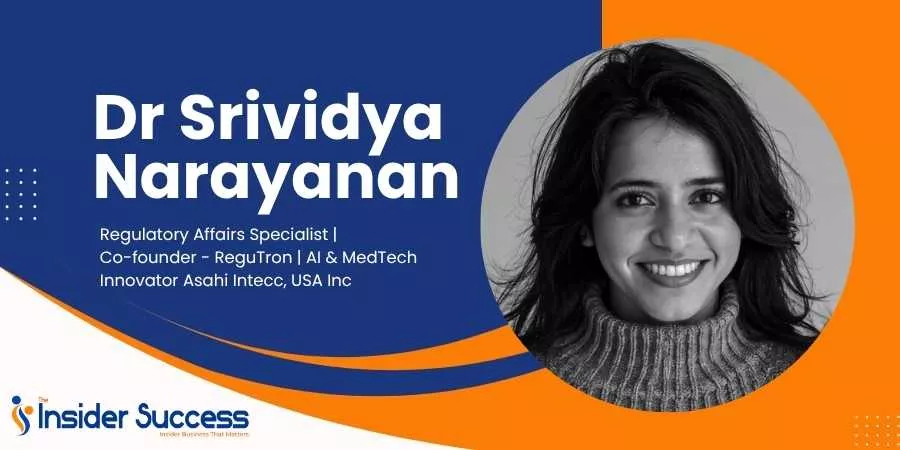
Srividya Narayanan has chosen to build her influence precisely there—at the convergence of clinical insight, regulatory science, artificial intelligence, and global MedTech strategy.
Her journey did not begin in boardrooms or conference stages. It began in the clinic.
From Chairside Care to System-Level Impact
As a practicing periodontist and implantologist in India, Srividya worked daily with implants, grafts, biomaterials, and surgical instruments. Each procedure required precision. Each device carried risk and responsibility.
But amid clinical routines, a deeper question began to take shape.
Who ensures these devices are safe before they ever reach my hands?
How are they evaluated?
Who determines whether they are fit for patient use?
That curiosity marked the turning point.
She realized patient safety is shaped not only by clinician skill but by regulatory decisions made long before a product reaches the operating room. Approval pathways, quality systems, design controls, and post-market monitoring quietly determine outcomes at scale.
If she wanted to protect more patients than she could personally treat, she would need to move upstream, to the systems that shape healthcare innovation itself.
This insight led her to pursue a Master’s in Regulatory Affairs at Northeastern University in the United States. Immersed in frameworks such as the FDA 510(k) pathway and global regulatory models, she discovered how profoundly innovation and compliance are intertwined.
Patient safety, she realized, is engineered long before surgery begins.
Clinical Perspective as Competitive Advantage
What distinguishes Srividya in regulatory affairs is not only technical knowledge but also lived clinical experience.
When reviewing a 510(k) submission or assessing Software as a Medical Device documentation, she does not see regulatory paperwork in isolation. She visualizes real operating rooms. She considers clinicians under pressure, emergency conditions, infection control risks, and usability constraints.
Her background in biocompatibility and infection control taught her early that safety is not theoretical. It is visceral, human, and immediate.
This perspective now informs how she approaches:
- Design controls
• Risk management files
• Human factors engineering
• Usability validation
• Post-market surveillance
Rather than treating compliance as documentation, she treats it as patient protection architecture.
Bridging Medicine and Technology
Many professionals choose between medicine and technology. Srividya rejected that binary.
Healthcare challenges are too complex for isolation. Medicine without scalable systems struggles to expand impact. Technology without clinical grounding risks solving the wrong problems.
When she transitioned into regulatory strategy, some questioned whether she was “leaving medicine.”
She saw it differently.
She was expanding medicine’s reach.
Through AI-driven platforms such as Regulatory Navigator and her foundational work with ReguTron, she began applying technology to simplify and accelerate regulatory pathways—ensuring safe devices reach patients faster and more equitably.
Identifying the Gap: Complexity as the Real Barrier
While mentoring aspiring regulatory professionals through Path2RAQA and Topmate, Srividya repeatedly encountered the same frustration among innovators:
“We don’t know where to start.”
Brilliant startups with clinically meaningful solutions were paralyzed, not by lack of science, but by regulatory complexity. Navigating the FDA, EMA, PMDA, and emerging markets required resources often unavailable to early-stage companies.
Established firms were spending months on regulatory research that could be reduced to days with structured intelligence.
This inefficiency was not sustainable.
Regulatory Navigator: Democratizing Access to Regulatory Clarity
Regulatory Navigator was born from that realization.
Designed as an AI-powered regulatory intelligence platform, it provides:
- Tailored regulatory roadmaps
• Real-time access to global authority guidance
• Auto-validated templates across 50 markets
• Multilingual support across 25+ languages
Its mission is clear: democratize regulatory intelligence.
Innovation should not depend on access to expensive consultancies. Small startups in emerging markets should have access to the same clarity as multinational corporations.
This is not about bypassing compliance; it is about making compliance accessible.
ReguTron: The GitHub of Regulatory Affairs
If Regulatory Navigator simplifies access to regulatory pathways, ReguTron transforms how regulatory knowledge evolves.
As a co-founder, Srividya is helping build what she describes as the “GitHub of Regulatory Affairs”—a collaborative ecosystem where regulatory professionals can:
- share regulatory submission strategies
- Real time FDA-AI feedback
- Learn from anonymized case-scenarios
- Reduce redundant research
Why should every company independently recreate similar 510(k) sections?
Why should regulatory expertise remain siloed?
ReguTron introduces collaborative intelligence into compliance. When new FDA guidance is released, users can access structured interpretations, implementation strategies, and validated frameworks rather than starting from scratch.
The result is reduced research timelines, from months to weeks, from weeks to days.
Regulatory becomes strategic infrastructure rather than an isolated effort.
Reframing Compliance as Strategic Intelligence
Regulatory affairs has long been perceived as a bottleneck. Srividya reframes it as competitive intelligence.
Organizations that integrate regulatory thinking from day one:
- Avoid costly redesigns
• Accelerate approval timelines
• Anticipate regulatory evolution
• Identify overlooked market opportunities
Through speaking engagements at RAPS, TOPRA Berlin, MEDevice Silicon Valley, and global industry forums, she consistently emphasizes one principle:
Regulatory strategy should inform product development from inception, not be retrofitted at submission.
The mindset shift is profound:
From “How do we get through regulatory?”
To “How do we use regulatory intelligence to win?”
AI, Automation, and the Evolution of Regulatory Science
Artificial intelligence is transforming regulatory research, quality systems, and post-market monitoring.
AI can now:
- Scan thousands of guidance pages
• Extract relevant regulatory requirements
• Generate compliance matrices
• Detect safety signals in real-world datasets
Yet Srividya is clear, AI does not replace professionals. It elevates them.
When combined with advanced regulatory intelligence platforms like ReguTron, AI enables predictive compliance systems by allowing teams to simulate regulatory submissions, identify compliance gaps early, and build structured documentation aligned with global regulatory pathways.
- Forecasting non-conformances
• Streamlining audits
• Enhancing CAPA management
• Identifying emerging safety risks earlier
Her long-term vision is ambitious:
Regulatory professionals should spend 80 percent of their time on strategic decisions and only 20 percent on administrative tasks.
Designing for Speed Without Sacrificing Safety
A common misconception in MedTech is that speed-to-market requires compromise.
Srividya rejects that entirely.
True speed emerges when regulatory thinking is embedded from the beginning. Early human factors studies, comprehensive risk files, and intelligent pathway selection (510(k), De Novo, EU MDR conformity routes) prevent delays later.
Speed achieved through shortcuts leads to recalls and reputational damage.
Speed achieved through intelligent regulatory design creates sustainable acceleration.
Cybersecurity as a Core Design Principle
As digital health expands, cybersecurity is no longer optional.
Regulators now expect:
- Continuous penetration testing
• Software bill of materials tracking
• Transparent vulnerability disclosures
• Algorithm validation documentation
For AI-enabled devices, modular design architecture and structured monitoring systems are critical to adapt to evolving FDA and EU frameworks.
Companies that build regulatory adaptability into their design will thrive.
Global Perspective, Strategic Depth
Having spoken at more than 30 conferences across three continents, including RAPS and DIA (Washington DC), TOPRA (Berlin), ISPE (Boston), PDA (Spain), and ASQ, Srividya has gained a nuanced understanding of regional regulatory dynamics.
While harmonization efforts progress, regional expertise remains essential. Market maturity, infrastructure, and regulatory interpretation vary significantly across geographies.
This global exposure strengthens her ability to design strategies tailored to FDA, EU MDR, APAC, and African markets, balancing global alignment with local realities.
Recognition such as placing among top professionals at TOPRA and winning the DIA 2025 Student Case Competition reflects the industry’s demand for leaders who integrate clinical, regulatory, and AI innovation expertise.
Resilience Forged Through Reinvention
Transitioning from established clinical practice in India to graduate study in the United States required extraordinary resilience.
Visa sponsorship barriers and thousands of job rejections tested her resolve. Rather than internalizing rejection, she reframed it as systemic limitation.
She rebuilt her professional identity from the ground up.
Her resilience today is rooted not in ego but in mission: accelerate safe healthcare innovation globally.
Redefining Women’s Leadership in MedTech
Women in technical leadership often confront false dichotomies: technical or relational, decisive or empathetic.
Srividya embodies integration.
She builds AI-compliant systems, advises on cybersecurity audits, mentors globally, and leads collaborative innovation—without compromising authenticity.
Through her work in regulatory science, digital health, and MedTech education, she is helping shape a new model of leadership where expertise, empathy, and impact coexist.
Mentorship as Infrastructure
Through Path2RAQA and Topmate, where she ranks among the top 1 percent of mentors globally—Srividya supports professionals navigating regulatory transitions.
She reminds clinicians, engineers, and scientists that their backgrounds are assets.
Technical fluency in AI, data governance, and cybersecurity will define the next decade of regulatory leadership.
Mentorship, she believes, is not an accessory. It is ecosystem infrastructure.
The Future of MedTech
Looking ahead, three forces will reshape healthcare:
- Adaptive AI-enabled medical devices
- Cybersecurity as a competitive differentiator
- Real-world evidence transforming regulatory approvals
Healthcare is shifting from episodic care to continuous, predictive, personalized ecosystems.
Medical devices will increasingly learn and adapt within regulatory frameworks. Regulatory science must evolve in parallel.
Legacy and Long-Term Vision
When asked about legacy, Srividya speaks of accessibility.
She hopes Regulatory Navigator ensures innovators from emerging markets access the same regulatory clarity as global corporations.
She hopes ReguTron is designed to reshape regulatory affairs from gatekeeping to strategic enablement.
She hopes Path2RAQA continues opening pathways for non-traditional professionals.
And she hopes future women entering MedTech see proof that leadership does not require sacrificing identity.
Technical excellence and authentic humanity can exist together, and the future of healthcare innovation depends on this balance.
Connect with Srividya Narayanan
LinkedIn Profile:
https://www.linkedin.com/in/srividyanara-dr/
ReguTron:
https://www.linkedin.com/company/regutron/
Regulatory Navigator:
https://www.linkedin.com/company/regulatornav/?viewAsMember=true
Northeastern University:
https://www.linkedin.com/company/northeastern-university-college-of-professional-studies/posts/?feedView=all
https://www.linkedin.com/school/northeastern-university/posts/?feedView=all