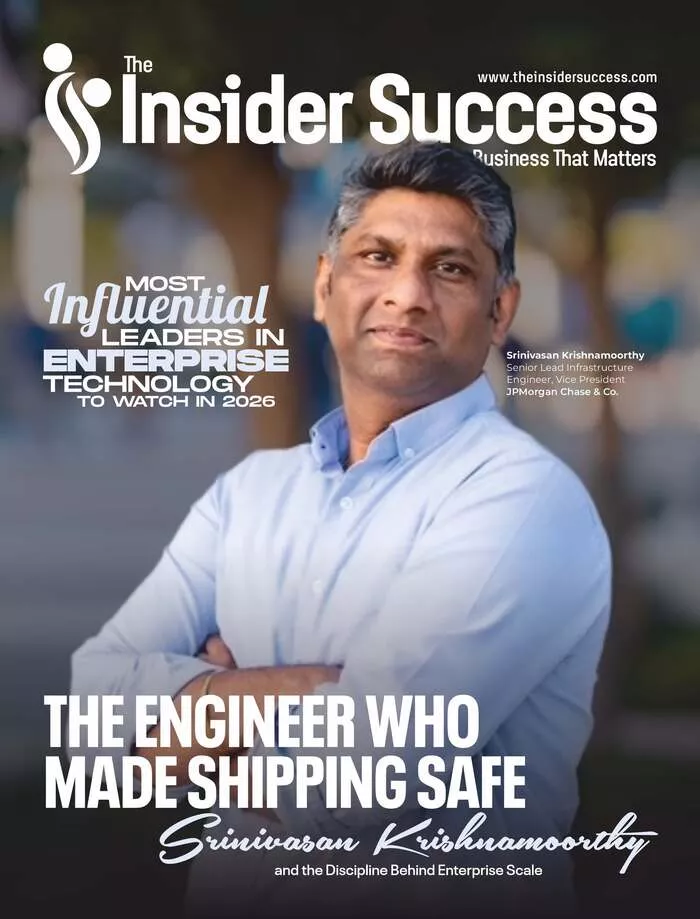


The Visionary Leader Who Sees the Whole Board
Every large institution has a layer that customers never see and regulators never stop asking about. It is the infrastructure underneath: the servers, networks, pipelines, and platforms that decide whether a bank opens its doors normally on a Monday morning. For Srinivasan Krishnamoorthy, that layer is not background noise. It is the craft he has spent his career mastering.
As Senior Lead Infrastructure Engineer and Vice President at JPMorgan Chase & Co., working from the firm’s Plano, Texas campus, he operates in one of the most complex and regulated technology environments in the world. His answer to the pressure of that environment is refreshingly simple: build systems so disciplined that safety and speed stop competing with each other.
The Foundation Beneath the Platform
Ask him what made it possible to operate at the Vice President level, and he does not start with a title. He starts with the basics. “My foundation was built through sustained hands-on engineering before leadership responsibility,” he says. Early work in systems administration left him with a principle he has never abandoned: “infrastructure is only as reliable as the discipline behind it.” Documented change, tested recovery, and clear ownership became non-negotiable habits, and they prepared him to take accountability for systems where failure reaches customers, regulators, and the institution itself.
That foundation rests on three pillars. The first is deep systems mastery. Long before managing large-scale cloud operations, he built his understanding on core system architectures, operating systems, networking fundamentals, and enterprise storage. Knowing how components interact at the lowest layers, he explains, gives an engineer the intuition needed to design fault-tolerant, multi-region architectures that hold up under pressure.
The second is architecting for reliability, security, and compliance. In financial services, uptime and security are not negotiable, so he built his career around zero-trust, highly automated infrastructure patterns that put compliance first without sacrificing velocity. Declarative configuration management, continuous testing, and proactive failure-mode analysis kept the platforms he worked on steady under heavy traffic and strict regulatory standards.
The third is translation. Operating at this level means bridging deep engineering and enterprise strategy, so he focused on turning complex infrastructure into self-service platform capabilities. Developers gained independence, operational friction dropped, cloud spending was optimized, and business units reached the market faster.
Shipping Should Not Be Scary
Krishnamoorthy works at the intersection of DevOps, cloud strategy, and infrastructure automation at the same time, and one conviction has guided nearly every technical decision he has made. “Software should be easy to ship, and shipping should be safe enough that teams are not afraid of it,” he says. He has tested every major choice against that belief, from pipeline design to cloud architecture.
Automation, in his view, is often misunderstood. “Automation is not a way to move faster at the expense of control,” he explains. “It is how control becomes repeatable, visible, and sustainable at scale.”
The most important lesson of his career, though, was not technical. His team had built fully automated CI/CD pipelines, container orchestration, and automated security scanning. On paper, the platform was complete. Yet adoption lagged. Operations teams feared losing control over production, while development teams saw new guardrails as extra overhead. “The obstacle was rarely the tool,” he realized. “It was the incentives, habits, and fear surrounding change.” From that point on, he treated DevOps adoption as a question of how people collaborate, with tooling as the supporting structure rather than the story.
When Pipelines Outgrow Their Speed
Krishnamoorthy designs and implements fully automated CI/CD pipelines across enterprise environments, and he has seen what happens when a pipeline built for speed meets the demands of scale. Shared dependencies become bottlenecks. Under heavy developer usage, build queues choke and a five-minute build can stretch into a forty-five-minute wait. Test suites that grow without pruning turn flaky, eroding trust and blocking the main branch. Security, treated as an afterthought, leads to leaked credentials and missed audits.
The fix, he says, is not more speed but more structure: standardized templates, environment parity, clear ownership of pipeline code, centralized policy-as-code gates, and observability into the pipeline itself. Agentic AI tools now help by analyzing recurring failure patterns and proposing fixes, but every proposed change still passes through the same review and control gates as human-authored work.
That emphasis on control carries into how he sees the wider automation gap across enterprises in 2026. Many companies have automated builds and deployments, he notes, but not the governance around them. Evidence capture, policy-as-code, and access controls remain manual or are assembled after the fact, especially in toolchains that span Jenkins, Maven, RTC, and Git. A newer gap is emerging as well: organizations are putting AI agents into delivery workflows without equivalent controls over their permissions, actions, and audit trails. His answer is to make compliance “a byproduct of the pipeline” and to treat every agent as a governed identity with scoped access. Teams are closing the gap, he says, by moving to unified platform engineering paired with AI-driven pipeline agents that correlate build logs with Git commits, summarize pull requests, detect environmental drift, and execute self-healing rollbacks before a human needs to step in.
What does a truly high-performing CI/CD environment demand? His first answer is blunt. “You cannot optimize what you do not measure.” Strong environments depend on testing strategy, observability, and rollback capability as much as pipeline mechanics, and on a culture where developers own what they deploy and operations share responsibility for reliability. In the best environments, predictive models analyze deployment metrics in real time and trigger automated canary rollbacks when they detect small anomalies in logs or telemetry, making recovery fast and frictionless.
Agile Inside a Bank
Leading Lean Agile practices across multiple verticals at a global bank brings its own challenges, and Krishnamoorthy is direct about the biggest one. In regulated environments, the most persistent barrier is the belief that Agile is a process layer on top of existing governance rather than a change in how decisions are made. Leaders who judge success by plan adherence instead of delivered value tend to rebuild waterfall timelines inside sprints.
Genuine adoption, he argues, asks leaders to accept shorter feedback loops, move gatekeeper governance toward automated and continuous compliance, surface risk early, and reward teams for learning rather than for looking on schedule. He makes the case with evidence: smaller, high-frequency releases that carry automated audit trails, vulnerability scanning, and immutable telemetry actually reduce risk compared with massive quarterly releases. “Replacing fear with data-driven confidence and psychological safety,” he says, “transforms compliance from an agile roadblock into an automated pipeline feature.”
The same thinking sits behind what he calls the one cultural shift that makes a DevOps transformation work: moving from departmental hand-offs to shared ownership and psychological safety. When developers are accountable for how their software runs, and operations engineers help shape how it is built, feedback loops shorten and quality becomes a shared responsibility. When failures happen, high-performing organizations swap finger-pointing for blameless post-mortems, treating outages as chances to refine automated checks and telemetry. Teams that feel safe, he says, automate, innovate, and deploy with confidence rather than fear.
Cloud Strategy and a Shared Language
On the cloud side, Krishnamoorthy leads strategies built on AWS and selects technology products using industry standards, so that IT priorities line up with business strategy rather than drifting away from it. The mistake he sees most often is also the most costly. “The most pervasive and costly mistake is treating migration as a lift-and-shift exercise,” he says. Moving workloads without rethinking architecture, cost controls, security boundaries, or the operating model simply transfers existing problems into a more expensive environment. Organizations that bring in cloud expertise early design landing zones, governance frameworks, and skills plans before the first workload moves, and they avoid discovering the gaps during an outage or an audit.
He is equally clear about what breaks when technology and business leaders do not speak the same language. Capital gets misallocated, shadow IT appears, and delivery friction grows. Technology leaders recommend platforms for resilience without tying them to a business outcome, while business leaders commit to timelines that ignore integration complexity. Investment drifts toward visible features, and risk stays abstract until an incident makes it real. His remedy is translation: expressing constraints as cost of delay, customer exposure, or regulatory risk, so that both sides can have a productive conversation.
Engineering at the Scale of Global Finance
What does infrastructure engineering at JPMorgan Chase demand that smaller environments never prepare you for? Krishnamoorthy points first to accountability. Every change must be traceable, every control auditable, and every failure explainable to regulators as well as engineers. Dependencies stretch from long-established systems to newer platforms, and an outage reaches well beyond the technology function.
Scale also changes the nature of monitoring itself. Smaller environments rely on dashboards and alert thresholds. At global financial scale, he notes, systems generate millions of events per second, which makes human triage during an incident inadequate. That is where predictive AI operations come in: machine learning that correlates telemetry across layers, detects small anomalies before outages occur, and performs autonomous remediation.
He has been applying AI to operations for the past two to three years, with strict boundaries. AI models support automated anomaly detection, pipeline failure triage, configuration review, and incident summarization, always with defined permissions, human approval for production-impacting actions, and full audit trails. In a low-risk-tolerance setting, he says, genuine innovation “looks less like novelty and more like making safe change faster.” It means proving ideas in controlled environments, building guardrails into the platform, and bringing risk, audit, and security teams in early as partners rather than gatekeepers. The most valuable uses of agentic AI so far, in his experience, reduce the cost of compliance and operational toil, as long as they stay within boundaries the institution can explain and defend.
What a Senior Leader Owes the Teams Who Depend on Them
Asked what a senior infrastructure leader owes the development teams relying on their work every day, Krishnamoorthy answers with three guarantees. The first is reliability they can plan around, with clearly documented platforms and honesty about limitations. The second is a customer mindset: because platform work sets the pace for everyone downstream, platform users should be treated as customers. The third is attention to experience, which means measuring its quality and responding quickly to friction.
His summary is as much a philosophy as a job description. “Trust is built through consistency over time, not through heroics during incidents.”
The Legacy He Hopes to Leave
Looking back on the teams he has led, the pipelines he has built, and the transformations he has driven, Krishnamoorthy is clear about what he hopes people will say. He hopes they will say that he made delivery at scale both safe and sustainable: that engineers could ship with confidence, that governance was built into the work rather than added afterward, and that people became better at learning from one another, including how to work alongside AI systems responsibly. The measure he cares about most is whether these systems and practices outlast any single initiative and continue to serve the people who depend on them.
Three ideas sum up what he hopes to be remembered for. He wants to show that intelligent automation and predictive AI operations can manage enterprise scale with zero-touch resilience, so that systems heal before users even notice a problem. He wants to build a culture where developers feel supported, platforms are painless to use, and continuous integration and delivery become an effortless daily standard. And he wants to prove that deep technical discipline, strong enterprise security, and agile business delivery do not compete with one another. Driven by clear vision, strong principles, and empathetic leadership, they amplify each other. In an industry that often treats speed and safety as a trade-off, that is a quietly radical idea, and it is the reason Srinivasan Krishnamoorthy belongs on any list of enterprise technology leaders to watch.