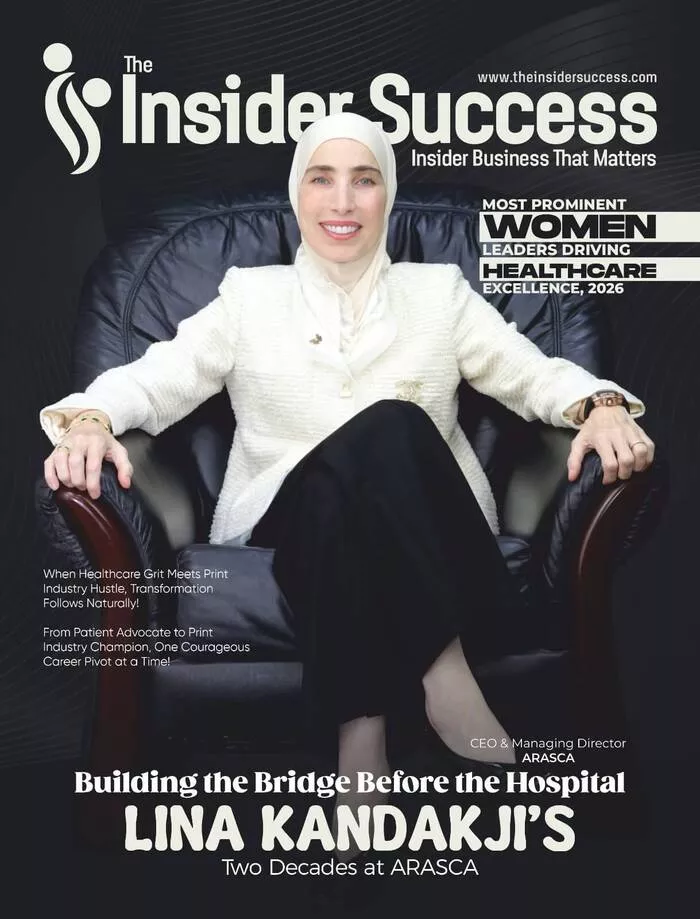


In 2007, Lina Kandakji identified a gap most people in healthcare hadn’t yet named: the critical window before a patient ever reaches a hospital.
As CEO and Managing Director of ARASCA, she has spent nearly two decades building the UAE’s pre-hospital medical equipment sector from the ground up, one trusted partnership at a time.
The Iconic Origin: Seeing a Gap No One Else Had Named
When Lina Kandakji founded ARASCA in 2007, she came to the UAE’s healthcare sector from business and marketing, not medicine, and it was precisely that outside perspective that let her see what others had missed. “The UAE’s healthcare sector was advancing rapidly, yet the pre-hospital domain, the critical period before a patient reaches a medical facility, remained inadequately serviced,” she explains. “I recognized that the market required more than products; it required a dependable partner committed to quality, accessibility, and service.”
That insight became the foundation for a company that has since grown from a single UAE operation into a trusted supplier across the GCC, Middle East, and North Africa, carrying more than 5,000 products. Kandakji is clear about what actually drove that expansion. “The defining decision was to build ARASCA upon a foundation of long-term partnerships rather than short-term transactions,” she says. “We concentrated on introducing trusted international manufacturers to the region and cultivating relationships grounded in reliability and mutual growth.”
ARASCA became the first company to introduce AEDs and evacuation chairs as product concepts in the UAE market entirely, a distinction that demanded more than commercial instinct. “Pioneering a new product category requires patience, conviction, and a willingness to educate the market,” Kandakji reflects. “When a product is novel, one is not merely selling it, one is articulating its significance and cultivating awareness of its value. Persistence is essential when adoption is gradual. However, witnessing these solutions become widely recognized, and more importantly, instrumental in saving lives, renders the journey profoundly worthwhile.”
Pre-Hospital Excellence and Life-Saving Innovation
Kandakji built more than a commercial supplier. Through ARASCA’s Public Access Defibrillator program, the company set out to place AEDs throughout UAE communities, a commitment she describes as inseparable from her broader philosophy about business itself. “I have always maintained that business should serve a purpose beyond commercial success,” she says. “An AED can prove decisive in the moments before professional medical assistance arrives; therefore, improving access to these devices was a matter I regarded as both important and necessary.”
That conviction eventually extended into policy itself. Kandakji worked directly with Dubai Tourism to make AEDs and first aid kits mandatory by law in all hotels, a level of influence few private business leaders attempt. “It requires courage, persistence, and genuine conviction in the cause,” she explains. “Government policy cannot be influenced merely by presenting a commercial opportunity; one must demonstrate why the proposed change serves the broader community. It also demands patience, as meaningful change is rarely achieved swiftly and typically requires collaboration among numerous stakeholders.”
ARASCA today spans eight product categories across military, disaster, ambulance, evacuation, and public safety applications, a breadth that Kandakji insists cannot come at the cost of consistency. “It is not feasible to lower standards in one area while maintaining them in another,” she says. “Every product reflects our reputation and may ultimately be deployed in a critical situation. Consequently, we remain highly selective regarding the manufacturers and products we introduce to our customers.” That same discipline is what has earned ARASCA its position as the sole and exclusive representative for 16 multinational partners. “They require more than evidence of sales potential,” Kandakji notes. “They need assurance that we understand their products, represent their brand with integrity, possess comprehensive knowledge of the local market, and are committed to long-term business development. A global brand entrusts us with its reputation, and we regard that trust as a matter of considerable responsibility.”
Leadership, Culture, and Building a High-Performing Team
Kandakji’s approach to her own team reflects the same investment she demands of her supplier relationships. ARASCA runs company-wide weekly knowledge sharing sessions covering products, technology, communication, and personality development, a scope well beyond typical job-specific training. “A capable employee is not defined solely by job performance,” she says. “I believe our people should continue to learn, communicate effectively, understand the broader business, and develop self-assurance. When individuals grow both personally and professionally, the entire organization is strengthened.”
That philosophy extends into how directly Kandakji involves herself in the business day to day. She conducts personal performance follow-ups with employees and handles customer complaints herself. “It demonstrates that I take responsibility for the standards we establish,” she explains. “I want our employees and customers to know that their concerns are heard and that quality is not delegated away. My direct involvement also enables me to understand challenges firsthand and to ensure continuous improvement.”
Leading a genuinely multicultural team across a demanding market, Kandakji points to a single unifying principle that keeps everyone aligned. “Respect is the foundational principle,” she says. “Individuals may come from different cultures, backgrounds, and perspectives, yet all must share the same expectations regarding integrity, responsibility, teamwork, and performance. Diversity becomes a genuine strength when individuals feel respected while working toward a common purpose.”
Quality, Standards, and the Cost of Never Compromising
ARASCA has never compromised on quality over price, a stance Kandakji admits has not always been the easiest commercial path. “There are instances when a lower-priced product appears more attractive in the short term,” she says, “however, I have always held that critical equipment should be selected on the basis of reliability and performance. The consequences of poor quality endure long after the advantage of a lower price has been forgotten. Over the years, this conviction has earned us customer trust, enduring partnerships, and a reputation we are committed to protecting.”
That commitment extends into how ARASCA treats the relationship between customer, distributor, and manufacturer. By working directly with manufacturers to feed customer feedback back into product development, Kandakji has built something closer to a continuous loop than a transactional supply chain. “It provides our customers with a voice that extends beyond the initial purchase,” she explains. “We are able to convey their experiences and requirements directly to manufacturers and to assist in translating that feedback into product improvements. This fosters a stronger relationship among the customer, ARASCA, and the manufacturer, rather than treating distribution as a purely transactional function.”
Vision, Legacy, and the Standard She Sets
Being recognized among the Most Prominent Women Leaders Driving Healthcare Excellence in 2026 has given Kandakji reason to reflect on what excellence actually means for a CEO whose products are deployed in the most critical moments of someone’s life. “For me, excellence signifies a full understanding of the responsibility inherent in every product we supply,” she says. “These are not merely medical products on a shelf; they may be employed when an individual is injured, vulnerable, or in danger. Healthcare excellence requires maintaining quality, acting responsibly, and never losing sight of the human life behind the equipment. Every AED, every evacuation chair, and every first aid kit carries that responsibility, and we bear it with humility and pride.”
Looking back on nearly two decades of building ARASCA, from the communities whose lives were saved by its AED program to the team she has led throughout, Kandakji is clear about what she hopes people remember most. “I would wish for them to say that I stood for integrity, quality, and purpose,” she reflects. “I hope they will remember that I believed in building something capable of making a meaningful difference, not only as a business, but in people’s lives. Most importantly, I want those who worked alongside me to feel that they were part of something built with passion, dignity, and a genuine commitment to serving others. Ultimately, what matters most is not the scale of the enterprise we built, but the difference it made in the lives it touched.”