


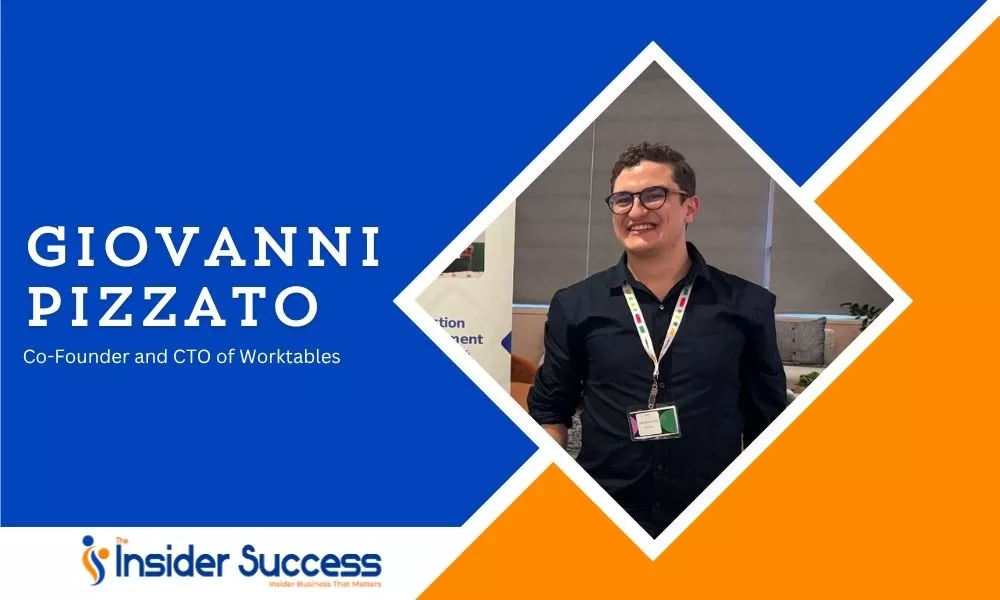
As Co-Founder and CTO of Worktables, Giovanni Pizzato is proof that the best workflow platforms are still built by the self-taught.
Most technology executives point to a degree. Giovanni Pizzato points to a video game. At twelve, curiosity about how his favorite games were built turned him into a self-taught coder. By fourteen, he was already building his father’s company website. What started as a hobby became a philosophy: learn by shipping, not by credentialing.
The path was not a straight line. College slowed him down, and the pandemic nearly ended it. Financial strain sent him home during COVID, and one missed in-person requirement during lockdown cost him his university spot. He turned the setback into momentum, building WhatsApp chatbots before AI made the idea mainstream, and working in virtual and augmented reality for live events. What he came out with was something no classroom teaches: design instinct sharpened by years of watching real users struggle, succeed, and struggle again.
That instinct now runs through Worktables, the company he co-founded with Managing Director Michael, whose sales and cybersecurity background complements Pizzato’s technical eye. Together they have grown Worktables from a two-person idea into a cross-border team spanning the United States and Brazil, building custom monday.com solutions for clients in manufacturing, real estate, logistics, cosmetics, and beyond. Their most ambitious work looks less like software and more like diagnosis: understanding a client’s entire operation well enough to replace scattered spreadsheets and status meetings with a single, intelligent system.
As CTO, Pizzato tracks two moving targets at once, the broader tech landscape and monday.com’s own fast-changing platform. His answer to AI reflects the same discipline he brings to everything else. Worktables lets AI handle the repeatable eighty to ninety percent of a task, while a human keeps the final, sensitive call, whether that means reviewing a contract or confirming an email before it sends. It is automation built on trust, not autonomy for its own sake.
That same instinct now drives Guided Workflows, Worktables’ newest release, an app that walks users through exactly what to do at each step instead of expecting them to already know. It is the natural next chapter for a builder who has spent his career making complicated systems feel simple enough for anyone to use. For Pizzato, that has always been the real skill: not the code itself, but knowing what someone actually needs it to do for them.
The Self-Taught Builder & Technical Origin
- You are entirely self-taught in technology, mastering programming languages, web development, and enterprise platform architecture without a traditional path. What drove that relentless self-education, and what did it give you that a formal degree never could?
At my core, I have a deep drive to keep improving how I solve problems, because becoming better every day is how you best serve the people you love. That drive shaped a very holistic, practical framework for learning: I started in graphic design and logo work, moved into user interface design, and then taught myself to code at twelve years old, purely out of curiosity about how my favorite video games were built. By fourteen, I was already helping my father with his company’s website.
College interrupted that momentum, then the pandemic ended it altogether: during COVID, financial strain forced me back to my hometown, and a missed in-person attendance requirement during lockdown meant I lost my spot at the university. That setback pushed me fully into self-taught, full-stack development. I built WhatsApp chatbots before AI made that mainstream, developed services, and worked at virtual reality and augmented reality companies creating live experiences for events. That path gave me something a degree couldn’t: a rare fusion of design instinct and technical depth, learned by actually shipping things across every screen and format imaginable. That fusion is the chemistry we now bring to every solution we build on monday.com.
- You describe yourself as humorous, communicative, and passionate about solving problems, three qualities not always associated with CTOs. How has that personality shaped the way you build both products and the teams behind them?
People absorb energy from each other, so I try to be a positive force in my team’s day, staying upbeat and communicative even while we’re serious about metrics and deadlines. Humor, communication, and passion aren’t separate from the work; they reinforce alignment. Everyone on the team needs to share the same vision: that Worktables exists to improve people’s lives through better digital workflows.
When that mission genuinely resonates, it shows up in how we approach every problem, always aiming to turn five minutes, thirty minutes, or a few hours of someone’s week into something easier and less anxiety-inducing. Keeping the mood light while tackling complex problems keeps everyone engaged and feeling good about the work itself.
- Your passion for problem-solving led you to master several programming languages. Which one changed the way you think about building solutions, and why?
Every language I’ve learned has changed how I see the bigger picture, from machine-level, physics-driven languages like C# and C++ to web-focused languages like JavaScript and HTML. I see them as complementary rather than competing. That said, web development has been the most influential in my career, because it’s put me in deep, constant contact with how people actually interact with technology: what buttons they press, how they receive information, whether a notification or an email is the right nudge.
Web’s versatility, running on anything from mobile devices to desktops to TVs and billboards, has made it the tool I’ve relied on most to simplify real user experiences.
monday.com Mastery & Platform Innovation
- You have helped organizations across every vertical streamline workflows using monday.com. What is the most creative or unexpected way a client has used a solution you built for them that genuinely surprised even you?
Most implementations land within the range of what I expect from the platform, since my mental model of monday.com’s structure is pretty solidified at this point. But one client genuinely surprised me: they took a monday.com board their internal team updated daily and used its native sharing capabilities to power live, public views on their website, essentially maintaining their entire product catalog and documentation library through shared monday.com views and docs.
It was a clever, resourceful use of native sharing to create a dynamic, self-updating customer-facing experience without building anything custom on top.
- You build custom monday.com apps, integrations, interfaces, and recipes entirely from scratch. When a client says “if you can think it, we can create it,” what is the most ambitious thing someone has asked you to think of and actually build?
The most ambitious projects tend to be full company overhauls, which require us to understand a client’s entire operational structure and align every stakeholder. But the single craziest feature we’ve shipped was for a shipping company importing containers globally. They wanted one monday.com board tracking every open container en route to different U.S. ports, complete with ETA, carrier, container codes, and live status.
We built web scrapers pulling live data from eighteen different carrier and port websites the client used to check manually, feeding it all into a single board and a live portal for their own customers. That single feature saves them thousands of hours a year, replaces error-prone manual updates with accurate live data, and has freed them to take on roughly three times more clients since they’re no longer stuck doing the grunt work.
- Most organizations implement platforms like monday.com and use 20% of what they are capable of. What is the gap between how companies think about work management and what is actually possible when the platform is fully unleashed?
The biggest gap is that most owners and stakeholders don’t fully understand the extent of their own operational issues going in. A large part of what we do at Worktables is diagnose first, similar to a doctor, before ever proposing a solution: why does a process exist, what does each step actually accomplish, why hold a weekly meeting at all. We turn weekly meetings into dashboards and loose spreadsheets into centralized monday.com boards.
Most companies arrive expecting something close to a glorified spreadsheet or task list. What we’re actually capable of delivering is a fully customized way of working, tailored desktop and mobile experiences that reshape how someone spends their entire workday. And with AI now layered on top, that gap widens even further: a mature enough system can move a company much closer to running on autopilot.
- As CTO you are simultaneously the chief architect, the lead problem-solver, and the technical voice of Worktables. How do you stay ahead of a technology landscape that changes faster than most organizations can adapt to?
Because we build technology on top of another platform, we’re tracking two moving targets at once: the broader industry and monday.com’s own rapid evolution, including recent overhauls to their AI platform, automation engine, and API, some of which introduce breaking changes. On top of that, every third-party integration we maintain comes with its own shifting APIs, pricing, and limits.
Mastering that complexity within a controllable framework is actually core to the value we provide clients. It requires constant internal innovation: identifying a recurring friction point in a teammate’s day-to-day, proactively solving it through a new workflow or app, and giving the whole team a repeatable way to keep pace with the platforms underneath us. That internal tooling is something I’m genuinely proud of.
Building Worktables & the Road Ahead
- Co-founding Worktables with a Managing Director whose background is sales and cybersecurity created a powerful partnership of complementary strengths. How do you and Michael make decisions when technology vision and business strategy pull in different directions?
This is where our partnership produces its best work, because a real constraint is often where creativity shines brightest. When business vision and technical feasibility don’t initially align, we iterate on both sides until we find the balance, sometimes through several rounds. Our deep friendship helps: I’ve picked up a lot of business and sales instinct from Michael, and he’s picked up a lot of technical instinct from me, so we tend to converge more often than not.
Where we do disagree, we work through it via iteration, though final technical feasibility always gets the last word, since we need certainty that what we envision can actually be built. We stay flexible throughout.
- AI is now embedded in every serious work management platform. How is it changing what you build for clients, and where do you see the next frontier of intelligent workflow automation heading in the next two years?
monday.com has been shipping AI functionality aggressively, from its AI Sidekick and AI columns to AI-powered workflows and agents, and we’ve been giving proactive feedback on all of it while testing internally, then rolling it into client accounts over the past couple of months to save hours of work daily.
Looking ahead two years, I expect the early hype that AI would fully replace humans to settle into a more mature view. Our sweet spot at Worktables reflects that: AI handles the repeatable eighty to ninety percent, and a human handles the final, sensitive step. A contract gets AI-drafted, then human-reviewed. An email gets an AI-generated draft, then a human confirms and sends it, rather than an agent auto-responding on the company’s behalf. The same logic applies to procurement: AI surfaces the right options, but a human places the actual order.
We deliberately avoid full autonomy on sensitive actions, which I think a lot of the agentic-AI demos of the last few years have glossed over. The goal is real time savings without the security and trust risks of unsupervised automation.
- What is the innovation inside Worktables right now, something you are quietly building or exploring, that the tech world has not yet seen but will be talking about soon?
It’s our Guided Workflows experience, an app we’re launching to the monday.com Marketplace this week that changes how people actually use software day to day. Instead of expecting someone to know which board, view, or column to use, the app tells the user exactly what to do at each stage: fill this in, review this, watch this instructional video, acknowledge this ticket.
It’s fully customizable by role and process stage, condensing what might be eighty columns on monday.com into a handful of intuitive tabs that even the most novice user can navigate on desktop or mobile. We can also embed a centralized, analyzed SOP board directly into the app. It’s built to fundamentally change how companies adopt new software, by having the software talk the user through it rather than requiring them to already know where to go.
In just a few years, Worktables has grown from a two-person vision into a cross-border team spanning the U.S. and Brazil, delivering solutions across manufacturing, real estate, logistics, cosmetics, and beyond. That range keeps things interesting: every industry brings a completely different problem to solve, and that variety is part of what keeps the work exciting day to day.