


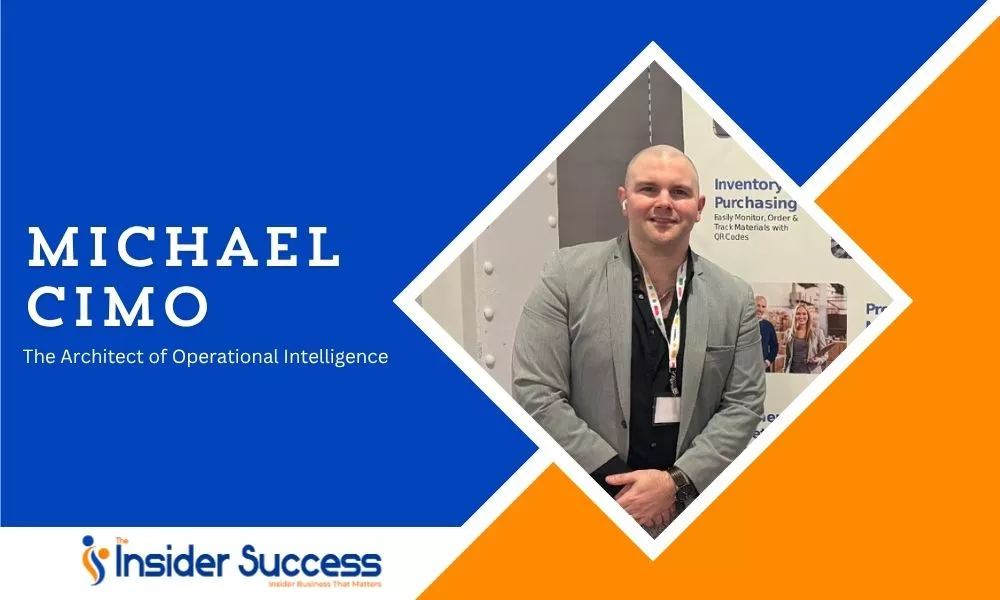
Turning Business Clarity into Digital Transformation!
Some executives arrive at leadership through pedigree. Others earn it through pressure.
Michael Cimo earned it through both.
His journey did not begin in a corner office or an executive training program. It began in one of the most unforgiving sales environments in the technology world, cybersecurity, where the stakes are high, the conversations are complex, and the margin for vagueness is essentially zero. Every deal demanded clarity. Every client conversation required trust built from scratch. Every solution had to speak the language of real operational risk, not feature sheets and product demos.
That environment shaped everything.
Today, as Managing Director of Worktables, Michael leads with a philosophy that is at once simple and quietly radical. Technology does not transform businesses. Visibility does. And his career, built across cybersecurity sales, business development, and people leadership, has been one long, disciplined journey toward helping organizations finally see themselves clearly enough to change.
As one of the most prominent tech executives leading digital innovation in 2026, Michael Cimo is not chasing the next shiny platform or riding the wave of AI hype. He is doing something far more valuable and far more rare. He is helping businesses understand what is actually broken before anyone reaches for a solution.
The Skill No Credential Can Teach
Ask Michael what has made him an effective Managing Director and he will not point to a degree or a certification. He will point to a habit of mind developed over years of sitting across from executives who thought they had a technology problem and discovering, through careful conversation, that they had something else entirely.
The greatest skill his career gave him was learning how to uncover problems that organizations did not even realize they had.
In cybersecurity, buyers rarely invested because of features. They invested because someone took the time to understand the operational risks hiding beneath the surface. Someone who asked different questions. Not what platform do you want, but what is slowing your business down. Where are your teams losing time. Where are decisions breaking down.
“Titles can open doors, but trust is what keeps them open. My role as Managing Director is not to push technology. It is to help organizations see their business differently. When you understand the real problem, the right solution often becomes obvious.”
That insight sits at the very core of what Worktables does. Not digitizing processes for the sake of modernization, but redesigning how organizations actually operate so that technology becomes a genuine advantage rather than another layer of expensive complexity nobody fully adopts.
What Cybersecurity Taught Him About Trust
There is a lesson that the cybersecurity world teaches its best salespeople early and teaches its mediocre ones never.
People do not buy because they are afraid. They buy because they trust the person sitting across from them.
Michael absorbed that lesson deeply. It changed how he communicated, how he listened, and how he understood the difference between a presentation and a real conversation. Executives do not need every technical specification laid out in front of them. They need clarity. They need someone who can translate risk, opportunity, and outcome into language that connects directly to what they care about most.
“The best sales conversations are not presentations. They are discoveries. When clients feel heard, they become collaborative. When they become collaborative, trust develops naturally. Once trust exists, closing is not about persuasion. It is simply the logical next step.”
That philosophy did not stay in the sales room. It followed Michael into every leadership role, every client engagement, and every conversation inside Worktables today. Whether the topic is AI, automation, ERP integration, or full digital transformation, the objective is never to impress. It is to provide enough clarity that the person across the table feels genuinely confident making an important decision.
Precision Is Not the Enemy of Speed. It Is What Makes Speed Sustainable.
In an industry that has long celebrated moving fast and breaking things, Michael Cimo holds a quietly contrarian view.
Innovation does not fail because organizations move too slowly. It fails because they move too quickly without establishing repeatable processes first.
Speed without structure creates technical debt. Inconsistent user adoption. Operational chaos that costs far more to untangle than the time saved by rushing. At Worktables, the philosophy is built around something more disciplined and ultimately more effective.
“Precision is not the enemy of innovation. Precision is what allows innovation to scale.”
Every system Worktables builds is designed to be scalable from day one. Workflows are documented. Stakeholders are properly understood. Adoption is measured. Assumptions are validated before expansion begins. And counterintuitively, this deeper investment in planning almost always accelerates delivery because teams spend dramatically less time correcting mistakes that should never have been made.
It is a philosophy that reflects Michael’s character as a leader. Thorough. Detail-oriented. Process-driven. Not because innovation makes him nervous, but because he understands that the organizations that sustain innovation are the ones that build it on something solid.
The Problem Most Organizations Cannot Name
Walk into almost any organization struggling with inefficiency and ask them what the problem is. Most will tell you they have a software problem.
Almost never is that actually true.
What they have, Michael has learned through hundreds of client engagements, is an operational visibility problem. Departments functioning in isolation. Employees building quiet workarounds nobody officially sanctioned. Institutional knowledge locked inside individuals rather than embedded in systems. Leadership making decisions without a reliable single source of truth.
By the time the symptoms become impossible to ignore, missed deadlines, duplicated work, communication failures, delayed decisions, the underlying process issues have typically existed for years.
“Technology does not create transformation. Visibility creates transformation. Technology simply enables it.”
This is the work Worktables does that no software vendor does. Helping organizations see how work actually flows before prescribing how it should flow. And the moment clients see an optimized process mapped clearly in front of them, something powerful happens. They immediately recognize inefficiencies they had unknowingly accepted as completely normal for years.
That recognition is where real transformation begins.
What Transformation Actually Looks Like From the Inside
Inside Worktables, efficiency is not a rallying cry. It is a discipline built around three deceptively simple questions asked constantly and consistently.
Can this be automated? Can this be simplified? Can this decision happen earlier?
Those questions shape everything the team builds. Developers are not writing software. They are solving business problems. Consultants are not configuring platforms. They are redesigning operational systems from the ground up. The sales team is not selling licenses. They are helping organizations fundamentally rethink how work happens.
One particular client transformation stands out in Michael’s mind, not for the technology deployed but for what it unlocked that nobody had anticipated.
A growing organization replaced fragmented multi-department processes with one connected operational ecosystem. Information that had lived scattered across spreadsheets, emails, and disconnected software was brought into a single intelligent system. Workflows were redesigned. Automations were introduced. Role-specific experiences were built so every employee saw exactly what they needed.
The unexpected result was not productivity.
“Managers finally trusted the data they were seeing. Employees understood their responsibilities more clearly. Leadership gained real-time operational visibility that allowed them to make faster, more informed decisions. Technology solved the workflow challenges. Confidence transformed the business.”
Confidence. That is what great operational design delivers when everything else aligns.
The Opportunity Most Executives Are Still Missing
In 2026, the conversation around artificial intelligence inside most boardrooms is still framed around productivity. Automating tasks. Saving hours. Reducing headcount in specific functions.
Michael believes that framing is thinking far too small.
“The real opportunity is organizational intelligence. AI should not simply automate individual tasks. It should connect information across departments, preserve institutional knowledge, recommend decisions, surface operational risks, and empower every employee with immediate access to organizational expertise.”
The companies that will define the next decade of digital leadership will not be the ones with the most AI. They will be the ones with the most connected AI. Systems that understand how a business actually operates rather than executing isolated tasks in disconnected silos.
That is the future Worktables is building toward. And Michael Cimo is building it with the same discipline, curiosity, and people-first instinct that has defined every chapter of his career so far.
Recognition as a Byproduct, Not a Destination
For the sales executive who started this journey with nothing but drive, discipline, and a relentless standard for results, being recognized among the most prominent tech executives leading digital innovation in 2026 carries genuine meaning.
But Michael holds that recognition lightly and deliberately.
He did not begin his career with every advantage. What he had was a willingness to outwork expectations, stay curious, and treat every client as a responsibility rather than a transaction. Every challenge became a lesson. Every implementation became part of a methodology that kept getting sharper.
“Lasting success is not built through titles or recognition. It is built through consistency. Show up every day. Stay curious. Solve meaningful problems. Invest in people. Keep raising your standards. If you do those things long enough, recognition eventually becomes a byproduct rather than the goal.”
That quiet philosophy, understated but unshakeable, is what makes Michael Cimo the kind of leader worth watching not just in 2026 but in every year that follows.
Because in a technology landscape full of noise, he is doing the harder, more valuable work of creating genuine clarity.
And in the end, clarity is what changes everything.