


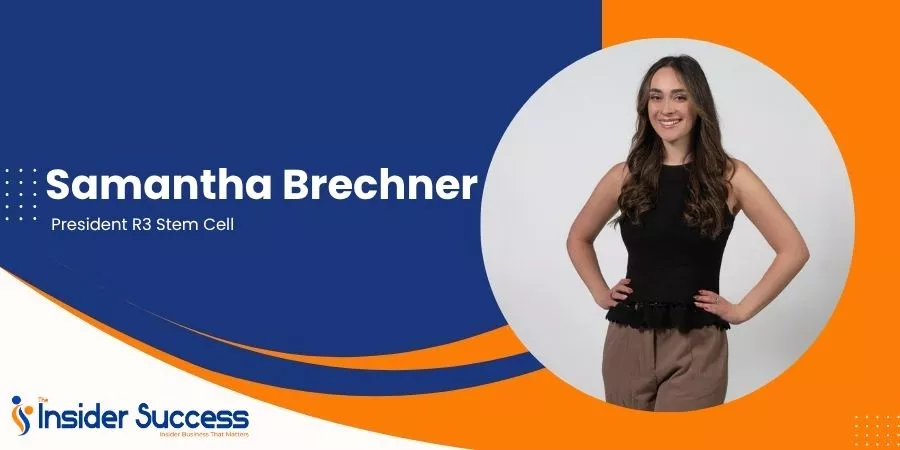
Samantha Brechner: Driving the Future of Regenerative Medicine with Purpose and Precision
Samantha Brechner: Leading with Purpose in a New Era of Regenerative Medicine
In healthcare, meaningful progress is never driven by innovation alone. Behind every advancement that truly transforms lives is leadership capable of turning scientific potential into real human impact.
For Samantha Brechner, President of R3 Stem Cell, regenerative medicine represents far more than an evolving healthcare sector. It represents an opportunity to improve lives through solutions grounded in science, education, accessibility, and trust.
Her journey into the field was shaped not by corporate ambition, but by conversations with patients searching for hope after years of chronic pain, mobility limitations, and unsuccessful treatment experiences. Those moments revealed something that would later define her leadership philosophy: advanced healthcare solutions only create value when patients can understand them, trust the process behind them, and feel confident in the decisions they make. This evolution also reflects the broader transformation taking place across MedTech and healthcare innovation, where technology and strategic leadership are reshaping the industry.
Today, Samantha leads with a vision centered on balancing medical advancement with operational discipline, patient education with accessibility, and growth with long-term credibility. Under her leadership, R3 Stem Cell continues strengthening its role within regenerative medicine by focusing not only on innovative therapies, but also on physician education, scalable systems, and patient-centered support designed to create sustainable impact.
A Journey Inspired by Human Experience
Samantha’s introduction to regenerative medicine came through firsthand exposure to patient stories that highlighted both the promise and complexity of emerging therapies.
She encountered individuals navigating chronic discomfort, restricted mobility, and uncertainty after exhausting traditional treatment options. Many were searching not only for alternative solutions, but also for guidance and reassurance during an overwhelming healthcare journey.
What stood out most to Samantha was the communication gap surrounding regenerative medicine. Patients were often introduced to highly technical information without fully understanding how therapies worked, what realistic expectations looked like, or how to confidently evaluate their options.
This realization shaped the foundation of her professional perspective. She recognized that healthcare innovation alone could never be enough. Patients also needed education, transparency, and systems capable of supporting informed decision-making.
That belief continues to influence the way she leads today. Whether strengthening operational structures, supporting provider training, or refining patient communication strategies, Samantha remains focused on creating healthcare experiences built on clarity, trust, and accessibility.
Building Leadership Through Accountability and Structure
After completing her MBA at Northern Arizona University, Samantha stepped into leadership with a practical, hands-on approach to organizational growth.
Rather than leading from a distance, she immersed herself in understanding the systems that support long-term scalability and operational consistency. She focused on identifying opportunities to improve communication, streamline workflows, strengthen collaboration, and create clearer alignment across teams.
This operational discipline quickly became one of her defining strengths.
In Samantha’s view, leadership is not simply about directing teams. It is about creating an environment where people can perform with clarity, accountability, and confidence. She believes organizations achieve sustainable success when expectations are clearly communicated, systems are intentionally designed, and individuals feel connected to a meaningful purpose.
At the same time, she recognizes the importance of empathy within leadership. Particularly in healthcare, strong leadership requires balancing precision with human understanding. Her ability to combine structure with approachability has helped her guide teams effectively within a rapidly evolving, science-driven industry.
Strengthening the Role of R3 Stem Cell in Regenerative Medicine
Under Samantha’s leadership, R3 Stem Cell has continued evolving into an organization focused not only on regenerative therapies, but also on education, provider support, and operational excellence.
As awareness around regenerative medicine grows, the industry continues facing challenges related to patient understanding, standardization, and credibility. Samantha recognized early that long-term success in this field would require more than offering advanced therapies. It would require building systems capable of supporting responsible growth while helping providers and patients navigate an increasingly complex healthcare landscape.
This philosophy has become a defining characteristic of R3 Stem Cell’s approach.
The company places strong emphasis on physician education through CME-accredited programs, training initiatives, and educational resources designed to help providers remain informed within a rapidly advancing sector. By prioritizing ongoing professional development, the organization helps strengthen consistency in patient care while supporting greater confidence among healthcare professionals.
Beyond provider education, R3 Stem Cell has also focused heavily on patient accessibility and communication. Samantha understands that many individuals entering regenerative medicine are seeking clarity as much as treatment. For this reason, the company continues investing in educational support systems that help patients better understand available therapies, treatment expectations, and long-term care considerations.
This patient-centered philosophy has helped the organization establish stronger trust within the marketplace while reinforcing its commitment to responsible healthcare practices.
Another area that distinguishes R3 Stem Cell is its emphasis on scalability supported by structure. Rather than pursuing rapid expansion without clear systems in place, Samantha has prioritized sustainable organizational growth built on consistency, accountability, and operational alignment.
That approach has allowed the company to continue expanding its reach while maintaining quality standards and reinforcing long-term credibility within the industry.
Advancing Healthcare Through Education and Innovation
Samantha believes the future of regenerative medicine will depend not only on scientific advancement, but also on how effectively the industry educates both providers and patients.
Although regenerative medicine continues gaining momentum globally, there remains significant need for education surrounding treatment applications, expected outcomes, and evolving research. Patients increasingly want transparent information that allows them to make informed healthcare decisions with confidence.
To address this need, R3 Stem Cell continues expanding educational initiatives and digital learning platforms designed to improve accessibility and understanding across multiple levels of care.
At the same time, the organization is integrating evolving technologies and data-driven insights to strengthen clinical decision-making and improve operational performance. Samantha sees technology as a tool that should support healthcare professionals, improve efficiency, and enhance patient experiences while preserving the human connection that remains central to quality care.
By combining provider training, educational accessibility, analytics, and scalable operational systems, she is helping create a healthcare model designed to support both advancement and reliability.
This balanced perspective reflects her broader philosophy on growth: progress must remain thoughtful, sustainable, and centered on long-term impact rather than short-term momentum.
Creating a Culture Centered on Purpose
Beyond strategy and systems, Samantha places significant emphasis on culture and team development.
She believes organizations thrive when individuals understand the purpose behind their work and feel genuinely supported in their professional growth. This belief influences how communication is structured throughout the company and how leadership teams collaborate across different functions.
Open dialogue, accountability, and teamwork remain central to the culture she continues building within R3 Stem Cell.
At the same time, maintaining high standards remains essential. Samantha believes healthcare organizations must continuously evaluate performance, improve systems, and reinforce consistency at every level of execution.
Her leadership style reflects this balance between support and accountability. By creating an environment that values both operational excellence and human connection, she has helped cultivate teams that remain engaged, adaptable, and aligned with the company’s long-term vision.
Navigating the Future of Regenerative Medicine
Leading within regenerative medicine requires the ability to adapt within a constantly evolving industry.
As technologies advance and research continues expanding, organizations must remain agile while maintaining credibility and operational discipline. Samantha approaches this challenge with a long-term perspective, understanding that sustainable success depends on careful planning, education, and responsible implementation.
She believes regenerative medicine will continue becoming more integrated into mainstream healthcare as awareness increases and research further validates the impact of these therapies.
At the same time, she recognizes that growth within the industry must remain grounded in transparency and patient trust. Organizations that prioritize education, accountability, and consistent standards will ultimately help shape the future direction of regenerative healthcare. The U.S. Food and Drug Administration (FDA) provides an overview of regenerative medicine and the types of therapies covered under its regulatory framework.
For Samantha, this responsibility extends beyond business growth. It involves helping create a healthcare environment where innovation remains accessible, understandable, and responsibly delivered to the individuals who need it most.
A Legacy Defined by Meaningful Impact
When Samantha reflects on long-term success, her focus extends far beyond titles or professional recognition.
She hopes to be remembered as a leader who helped build something meaningful—an organization that not only expanded within a competitive industry, but also improved experiences for patients, strengthened support for providers, and created opportunities for people throughout the organization.
For her, success is measured by lasting impact.
It is reflected in the confidence patients feel when exploring new possibilities for care. It is seen in the healthcare professionals who continue advancing their knowledge and capabilities. And it is reinforced through systems designed to support quality, consistency, and long-term trust.
Because in the end, leadership is not simply about growth or visibility. It is about creating progress that genuinely improves lives and continues making a difference well into the future.